 By Pepper Parr By Pepper Parr
May 29th, 2026
BURLINGTON, ON
I needed to get some fresh air after dinner and before heading to the Performing Arts Centre for their Members Only event.
I decided to walk out to the end of the Pier and enjoy the lake for a few minutes.
The Gazette covered the construction of the Pier like a wet blanket when it was being built.
 There are other ways to leave your mark. This kind of graffiti takes away what the Pier has to offer to those who look for some peace and quiet and a place to sit down and chat with friends.
There was an attachment to the place that was marred by the graffiti that people had scratched into the metal rail. Made the place look a little shoddy and took away the pristine look people have come to expect.
The city is now going to have to send staff out to repaint the metal railings. And maybe install a politely worded message asking people to respect the place.
Put security camera up and capture the miscreants who do things like this.
s

 By Gazette Staff By Gazette Staff
May 29th, 2026
BURLINGTON, ON
New analysis from Canada Mortgage and Housing Corporation (CMHC) finds that housing starts in Canada could have been nearly 30% higher from 2006 to 2024, and home prices close to 10% lower, if regulatory conditions, along with economic and demographic structural factors, allowed housing supply to respond more quickly to increases in demand. In this article, CMHC’s Chief Economist, Mathieu Laberge compares the responsiveness of the Canadian and U.S. housing industries over this period.
 We could have built a lot more housing and lowered the prices if the municipal bureaucracies had been reigned in. One factor in determining the pace of housing construction is land use regulation. In the United States, there are fewer zoning and land use constraints in many metropolitan areas. In contrast, tighter land use rules in Canada, particularly in major urban centres, have made it more difficult to add new housing supply in a timely manner.
Other economic and demographic structural factors also played a role in the poorer performance of the Canadian residential construction industry relative to the US industry. For example, housing demand in Canada is concentrated in a smaller number of large urban centres, giving households fewer comparable and affordable alternatives if they choose to move. This reduces incentives for the industry to react quickly to changes in housing demand. In contrast, the U.S. benefits from a larger network of major cities with similar job opportunities, which can help distribute demand more evenly and support a more responsive housing supply.
The experts appear to be saying that the bottleneck is at the municipal level; the people you elect.
 By Gazette Staff By Gazette Staff
May 29th, 2026
BURLINGTON, ON
The buildings around us shape the way we see the world we live in
The Ontario Association of Architects (OAA) has revealed the winners of its 2026 Design Excellence Awards, as well as its Service Awards program. These projects, practices, and individuals will be celebrated at this year’s OAA Conference, Collaboration Powering Innovation, taking place next month in the Waterloo Region.
The OAA regulates the practice of architecture in the province to protect the public interest. Its biennial Design Excellence Awards program celebrates the work of Ontario practices anywhere in the world. This year’s collection features a diverse range of building types, including sustainably designed community centres, innovative housing solutions, revitalized academic and cultural facilities, and transformative public spaces.
Check out three of the ten we want to share with you.
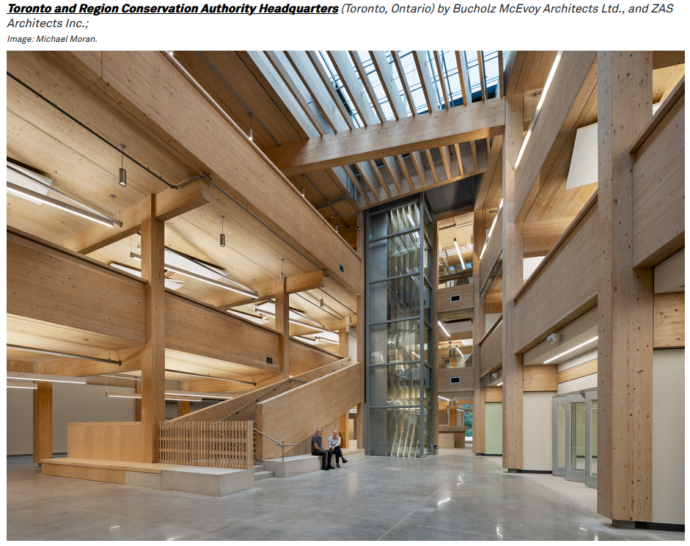


For a look at all the award winners, click HERE
By Gazette Staff
May 28th, 2026
BURLINGTON, ON
This City Council has a practice of recognizing people for their accomplishments.
Last Tuesday, Council recognized city staff who came up with $63,100.81 as their contribution to the United Way Golden Horseshoe 2025 fundraising campaign.
 A cheque for $63,000 plus was sent to the United Way. Ian Maglonzo from Community Planning is the Chair of the employee United Way Committee spoke of the $63,100.81 that went to the United Way Golden Horseshoe fund raising campaign. “This was accomplished through the city payroll deduction program and staff events, such as the annual softball tournament with the town of Oakville and Burlington Economic Development Tourism Chile Cook Off. A shout-out went to Councillor Bentivegna for winning the Celebrity Chef Award this year.”
I want to take the moment to thank Council, the Burlington Executive Leadership Team, the Burlington Senior Leadership Team, and our unions, including Locals 2723 and 44 and IAFF Local 1552 for their continued support in the United Way Committee, city staff who have participated and contributed both to our events and payroll deduction.
 Jennifer Loker Members of the committee who have joined me today are: Amanda D’Angelo from Community Planning; Stephen Camm from Transportation Services; Jayson Doll from Government Relations; Laura Guberney, from Recreation, Community and Culture; Craig Kummer from Transportation Services and Amy Daca from Engineering Services
Jennifer Loker, Chief Development Officer for the United Way Golden Horseshoe, spoke of what some of the people who supported the campaign did individually.
.
By Gazette Staff
May 28th, 2026
BURLINGTON, ON
United Way Golden Horseshoe brought together leaders from across the financial services sector for its annual Champions for Change Luncheon, an event focused on leadership, philanthropy, and collective action. This year’s luncheon raised over $200,000 in support of local community programs and services across the Golden Horseshoe.
Champions for Change has served as a meaningful opportunity for industry professionals to come together, share ideas, and align their efforts to strengthen communities and support those facing complex challenges.
 Champions For Change Financial Services Luncheon Committee “Champions for Change is a powerful reminder of what can happen when leaders come together with a shared sense of purpose,” said Brad Park, President & CEO, United Way Golden Horseshoe. “The funds raised through this event will directly support programs that help individuals and families access food, housing, and mental health services. More importantly, it strengthens the network of support across our communities, ensuring people have somewhere to turn not just in times of crisis, but every day.”
The event was founded by Marc Hamel, Associate Portfolio Manager with Manulife Wealth, who continues to champion the role of the financial services sector in giving back.
“It’s incredibly encouraging to see the financial services community step forward in such a meaningful and collective way,” said Marc Hamel. “This event reflects the values of our industry. It’s about leadership, giving back, and recognizing that we all have a role to play in supporting the communities where we live and work. When we come together like this, the impact is real and lasting.”
This year’s luncheon featured keynote speaker Sébastien Sasseville, one of the world’s most accomplished endurance athletes. Living with Type 1 diabetes, Sasseville has summited Mount Everest, run across Canada, and completed some of the toughest endurance challenges on the planet. His message of responsibility, purpose, and perseverance deeply resonated with attendees, inspiring leaders to stay focused, adaptable, and committed to long-term impact.
 “Events like this show the strength of our region when we work together,” added Park. “As United Way Golden Horseshoe, we are proud to stand alongside partners across sectors to help build stronger, more connected communities where everyone has the opportunity to thrive.” “Events like this show the strength of our region when we work together,” added Park. “As United Way Golden Horseshoe, we are proud to stand alongside partners across sectors to help build stronger, more connected communities where everyone has the opportunity to thrive.”
By Gazette Staff
May 28th, 2026
BURLINGTON, ON
Parking, it is a consistent and persistent problem for the city. Merchants want space for their staff, and residents want to be able to park their car when they are shopping or dining downtown.
The Burlington Downtown Business Association (BDBA) presented city Council with a petition signed by 60 people. The 60 signatures from the 400 plus members of the BDBA must have been disappointing. Especially given the notices that were sent out to the membership.
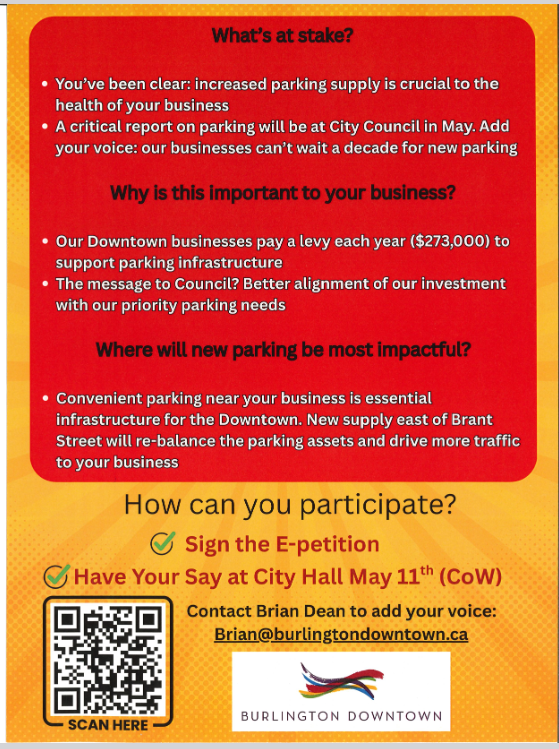
We, the undersigned, AGREE that public parking supply Downtown has not kept pace with development pressures.
New mobility initiatives designed to move patrons around our Downtown are welcomed, and in process, BUT parking is CRITICAL to the health of our business community, and it must be delivered now.
We support the BDBA’s demand to deliver NEW public parking by 2030. We STRONGLY encourage City Council to approve a plan that will deliver a new parking facility as a short-term priority.
The step the BDBA wanted taken was the approval of funding for a study that would determine where parking could be located east of Brant and who would provide the space.
 By Gazette Staff By Gazette Staff
May 28th, 2026
BURLINGTON, ON
This is a little early but the space on the rooftop of the Joseph Brant Museum is very limited.
 The sightlines over the Pier and to the west are incredible. The sightlines over the Pier and to the west are incredible.
Enjoy an evening of food, drinks, games, and live music with a premiere view of Burlington’s Canada Day Drone Show & Fireworks!
Fireworks from the Rooftop at Joseph Brant Museum on July 1, 2026 from 7:30pm-10:30pm.
Guests will enjoy classic Canadian favourites including pulled pork, macaroni salad, chips, beer, and ice cream all while taking in a panoramic view of Downtown Burlington from the museum’s Rooftop Terrace.
Beverages will include beer from Nickel Brook Brewing Co. and wine from 13th Street Winery. There will be lawn games available to play and live music from Josh Edwards throughout the evening. The event will end with the City of Burlington’s Canada Day Drone and Firework Show, starting at 9:40pm.
Guests are encouraged to bring their own lawn chairs.
Ticket includes food, entertainment, and 1 drink ticket. Cash bar available. This is a 19+ event. The event will be moved indoors in the case of inclement weather.
Book tickets HERE
Tickets are $50 per person; members – $45.
 By Gazette Staff By Gazette Staff
May 29th, 2026
BURLINGTON, ON
Most of us know a Robin or a Blue Jay when we see them, especially the Blue Jays – they make so much noise.
But what about the other hundreds of birds that share this community with us? The woodpeckers, the sparrows and the red winged blackbirds?
A guided tour of the birds that fly around City View Park is taking place June 6th. Give it a thought.

 By Pepper Parr By Pepper Parr
May 28th, 2026
BURLINGTON, ON
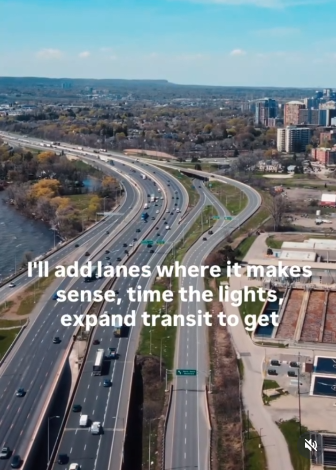 A Mayor has one vote at Council meetings. A Mayor has one vote at Council meetings.
If there is an initiative a Mayor wants to proceed with, they have to convince the other members of Council to vote for the idea.
Rory Nisan doesn’t appear to understand that. In an Instagram reel Nisan explains how he will get things done, apparently all by himself.
Lot of learning to be done.
We think Nisan now understands where HST dollars go. During a Standing Committee, Nisan actually asked the Chief Financial Officer: “Who gets the HST dollars.”
 By Velma Preston By Velma Preston
May 28th, 2026
BURLINGTON, ON
Burlington’s municipal government is under growing pressure to modernize how residents and businesses interact with city services.
Across Ontario, local governments are grappling with the same challenge.
The issue is that legacy payment systems, which were designed for in-person transactions, are increasingly at odds with the expectations of a digitally connected population. For Burlington, the gap between current infrastructure and resident demand is becoming harder to ignore.
That pressure has accelerated in 2026 as the city enters the final stage of its multi-year “Vision to Focus” transformation strategy, which prioritizes customer-centric digital services and updated payment infrastructure across municipal departments.
Council Reviews Digital Payment Gaps In Services
Burlington’s current payment system still reflects a model built around physical access. Property tax payments, for example, often rely on cheques, in-person debit payments at the Service Burlington counter, deposit boxes, or transactions through financial institutions. Some online banking options are available, but there is still no single portal that brings all municipal payments together in one place.
This fragmented system creates clear inefficiencies. Businesses renewing licences or applying for permits often face different processes depending on the department involved. Digital access also varies across services, making the overall experience inconsistent for residents and local businesses alike.
Council has acknowledged these issues as part of wider discussions around city modernization. In 2026, that conversation has become more urgent as Burlington enters the final phase of its multi-year “Vision to Focus” strategy. The plan prioritizes customer-focused digital services and broader technology upgrades across municipal operations.
Part of the city’s goal is to standardize how residents access and pay for services online. Burlington is also aiming to improve engagement across its digital platforms as more services move into digital-first environments.
External infrastructure changes are adding further momentum. Canada’s rollout of Real-Time Rail payment systems is expected to change how municipalities process transactions. For Burlington residents, this could eventually mean faster settlement times for payments such as property taxes, parking fines, and permit fees. Instead of waiting days for transactions to clear, payments could be processed almost instantly.
At the same time, the council is weighing accessibility concerns alongside modernization efforts. Burlington Transit’s current accessibility planning includes efforts to move more subsidy applications and specialized transit bookings online. That has raised broader discussions around digital equity, particularly for older residents and people who may still depend on traditional service access.
Real-Time Payment Systems Gain Attention
As Burlington explores new digital payment systems, much of the conversation is being influenced by how quickly private-sector platforms have adapted to real-time banking technology. Canadian consumers are increasingly used to instant transfers, fast confirmations, and simplified online payment flows across digital services.
That is one reason why Real-Time Rail infrastructure has become such an important topic in 2026. The national rollout is expected to modernize how payments move between Canadian financial institutions, reducing delays tied to traditional settlement systems.
For municipalities, the appeal is obvious. Faster processing could reduce administrative bottlenecks tied to parking fines, permit applications, utility bills, and property tax payments. Instead of waiting days for transactions to clear, residents could receive near-instant confirmation that payments have been processed successfully.
Private-sector payment processors are already operating within this environment. In regulated digital industries, platforms connected to gigadat casinos show how Interac-based payment gateways can handle secure, high-volume transactions with real-time confirmation. These systems allow users to move funds directly through their online banking platforms without relying heavily on credit cards.
The broader appeal for institutions is the underlying infrastructure. Payment gateways that use bank-backed verification reduce fraud risks while improving transaction speed and user trust. That model is increasingly influencing conversations around digital service modernization across Canada.
Digital Expectations Continue To Shift
Burlington’s digital push also reflects changing consumer behaviour. Residents now expect municipal services to operate with the same convenience they experience in banking, retail, and other online platforms.
The city’s 2026 goals include improving engagement across digital services while making online systems easier to navigate. Part of that process involves standardizing how residents interact with city departments rather than forcing users through disconnected systems.
Local businesses have been especially vocal about reducing administrative friction. Separate payment systems, physical paperwork, and delayed processing times create avoidable costs for operators renewing licences or managing permits.
A more unified digital system could streamline many of these processes. It could also improve transparency around payment tracking and application status updates.
At the same time, accessibility remains a major consideration. Burlington Transit’s accessibility planning already includes efforts to move more subsidy applications and specialized bookings into digital-first systems. Council members continue to balance modernization goals with concerns around digital equity, particularly for older residents and those who still depend on traditional service methods.
Burlington Moves Toward Long-Term Digital Modernization
While no final procurement decisions have been announced, Burlington’s direction has become increasingly clear. The city is moving toward a more centralized digital service model supported by updated payment infrastructure and national digital standards.
Federal guidance around digital governance, cybersecurity, and accessibility is expected to shape how municipalities implement these systems over the next several years. Burlington’s current transformation strategy places strong emphasis on long-term scalability rather than short-term fixes.
For residents, the practical impact could eventually be significant. Faster payment confirmations, fewer in-person visits, and simplified online access may become standard features of everyday municipal services rather than optional conveniences.
 By Pepper Parr By Pepper Parr
May 27th, 2026
BURLINGTON, ON
OPINION
Getting elected means getting in front of as many people as you can.
Ward 3 Councillor Rory Nisan, now a candidate for the office of Mayor, announced that he is holding a Launch Party on May 31st.
The Launch will take place from 2:00 to 4:00 pm.
Where?
You have to ask if you can attend before they tell you where it is going to take place.
And this guy wants to be Mayor?

By Pepper Parr
May 27th, 2029
BURLINGTON, ON
A Gazette reader asked us earlier today whether Lisa Kearns election campaign for Mayor was being funded by developers.
 Campaign donations come from ordinary people who believe in the candidate. Most candidates put up a large amount of their own money to finance their campaigns. How would we know that?
Nevertheless, we asked Kearns about campaign donations from developers.
Her response:
“The campaign is being funded by anyone that uses the donation link on the website.
“At this time I do not have any developer donations, in the past I have not received any developer donations.
“Donation maximums are $1200, the preliminary maximum campaign contributions for Office of the Mayor is $127,566.75, so even if “a developer” donates, it would not be material enough to influence platform.”
Burlingtonians have always had an issue with developers donating to election campaigns. Why they should be discriminated against when it comes to where they put their money is something I’ve never understood. They are expected to donate heavily to the hospital and some do.
Every candidate is required to submit an audited report on who donated to their campaign. It’s public information.
By Gazette Staff
May 27th, 2026
BURLINGTON, ON
Burlington MP Karina Gould rose in the House of Commons yesterday to speak to a petition signed by more tha 600 Canadians.
Mr. Speaker, between 1945 and the 1970s, hundreds of thousands of unmarried mothers in Canada were coerced into surrendering their babies for adoption.
 Karina Goud speaking in the House of Commons. Source Gazette photo bank. This occurred under intense pressure from religious organizations, social workers and the medical community, particularly in maternity homes and hospitals.
I first learned about this shameful part of Canadian history from a 2018 Senate report, led by the Hon. Art Eggleton, entitled “The Shame is Ours”. I got to know the courageous Valerie Andrews, a survivor of this cruel practice and tireless advocate with Origins Canada for the mothers whose babies were taken from them. I read Heather Marshall’s profound book, Looking for Jane, which sheds light on the treatment of unwed mothers in Canada in the post-war years.
Australia, Wales, Scotland and Ireland all had similar practices and all have acknowledged the historic wrongs these women and their children were subjected to. These women, those who are still alive today, are elderly, and they deserve to know that what happened to them was wrong.
In the postwar years, over 300,000 unmarried young women had their babies forcibly removed after giving birth. In 2018, the Senate released the report “The Shame is Ours”, calling on the government to implement four recommendations to right these historic wrongs. These women and children, because of outdated adoption laws, have not been able to find each other and have not been able to get closure.
On behalf of the hundreds of these women in Canada still alive today, and their children, petitioners are calling upon the government to implement the recommendations of the Senate report and to make amends for this historic wrong.
By Norm Coles
May 27th, 2026
BURLINGTON, ON
Paying for groceries, transit, subscriptions, travel bookings and household services now depends on trust as much as speed. Canadians use cards, wallets and online transfers because they are convenient, but every payment also asks a simple question: is this platform safe enough?
Consumer guides such as American Express casinos in Canada are useful because they show how Amex-friendly online platforms are compared by card security, payment rules, fees, withdrawal conditions and operator reliability before users trust a card in a high-risk digital setting.
Cash is still present, but cards set the pace
Cash has not disappeared. It still works for small purchases, tips, local markets and people who prefer visible budgeting. The larger payment story has moved elsewhere. Canada recorded 22.5 billion retail payment transactions worth $12.2 trillion in one recent annual period, showing how deeply digital payments now sit inside daily life.
Credit cards represented 33% of transaction volume, while debit cards accounted for 30%. Cash held 11% of payment volume. That split shows a mature market, not a cashless fantasy. People still use cash, but cards and digital transfers now carry the weight of routine spending.
 Fumbling through a purse for cash to pay the grocery bill can slow down checkouts. Contactless behavior is the clearest signal. Canadians made about 13 billion contactless transactions, representing 58% of total payment volume. Tap payments have become normal because they solve a practical problem: fast checkout without handling bills, entering a PIN for every small purchase or slowing a line.
Convenience created a new trust problem
Speed changed expectations. A payment that takes ten seconds now feels normal. A checkout that asks too many questions feels suspicious or outdated. That creates pressure for merchants, banks and platforms to balance ease with verification.
Digital trust depends on details that most people only notice when something goes wrong. A clean checkout page, clear merchant name, recognizable card network, visible refund policy and two-step authentication can decide whether a customer finishes a transaction.
The strongest payment experiences usually share several practical signals:
- clear pricing before checkout
- visible merchant identity
- secure card authentication
- simple refund and dispute rules
- transaction records sent quickly
- no surprise currency or processing fees
- customer support that can be reached
These signals matter across ordinary purchases. They matter when residents pay for home services, buy event tickets, renew memberships, order online or book travel. The more payments move online, the more trust becomes part of the purchase itself.
Fraud made payment safety a household concern
 Fraudulent transactions were 300% higher than in 2020 Fraud is no longer a niche banking issue. Reported fraud losses in Canada reached $643 million in one recent annual count, nearly 300% higher than in 2020. The real figure is likely higher because many victims do not report losses.
The risk has changed because scams now look professional. Fake invoices, copied websites, urgent texts, marketplace fraud, investment pitches and account takeover attempts can all look credible at first glance. A household payment can become a security decision in seconds.
Card networks and banks have responded with stronger protections. American Express uses SafeKey for participating online merchants, which can confirm identity through a one-time code or security check. Canadian consumers also have protections against unauthorized credit and debit transactions when they meet their responsibilities and report issues quickly.
That does not remove risk. It changes the standard. A modern payment method is judged by how well it prevents fraud, detects unusual activity and gives the customer a path to challenge a suspicious charge.
Premium cards are judged by control, not status
Premium cards used to be discussed mostly through rewards, travel perks and recognition. That view is too narrow now. Consumers judge payment methods by security, acceptance, dispute handling, digital controls and how clearly each platform explains its terms.
American Express is a good example because it often appears in conversations about premium card use, purchase protection and online security. For consumers, the practical question is not whether a card sounds prestigious. The question is whether the merchant accepts it, whether authentication is clear and whether the platform explains deposits, withdrawals, refunds or fees before payment.
 The card choice can shape the whole transaction. This matters because card choice can shape the whole transaction. Some merchants accept every major network. Others limit options because of processing costs or technical setup. Some digital platforms support cards for deposits but use other methods for withdrawals. A careful payment page explains this before the user commits.
Clear payment rules now shape consumer confidence
The next stage of digital payments will not be won by speed alone. Fast payment is already expected. The real advantage belongs to platforms that make rules easy to understand before money moves.
That shift can be seen in everyday behaviour. People compare checkout methods before buying, check reviews before entering card details and notice when a platform hides fees until the final screen. Payment trust has become part of consumer literacy.
Businesses that want confidence need to make payment information visible:
- accepted cards and wallets
- refund timelines
- identity checks
- transaction limits
- possible fees
- dispute channels
- data protection basics
 Digital payments changed more than checkout. A trustworthy payment experience does not need to feel complicated. It needs to feel honest. People want convenience, but they also want proof that their money and personal information are handled properly.
Digital payments changed more than checkout. They changed how people judge businesses, platforms and services. The card, wallet or transfer method is now part of the public trust equation, and consumers are becoming more selective with every tap, click and confirmation.
 By Denis Green By Denis Green
May 27th, 2026
BURLINGTON, ON
Ontario’s regulated online gambling market pulled in $4 billion in gross gaming revenue during 2025. That’s a 34 percent jump over 2024, and it pushed the province’s cumulative haul past $10 billion since the market opened in April 2022. Nearly $98.3 billion in wagers flowed through licensed platforms over those twelve months, which means the average Ontario bettor wasn’t just signing up – they were coming back, week after week, and spending more each time. Three years ago, plenty of analysts doubted whether Ontario’s open-market model could pull revenue away from offshore sites. Those doubts look pretty silly now.
The numbers aren’t slowing down in 2026, either. January alone saw $9.5 billion in total handle, and March topped that with $9.6 billion – a new all-time monthly record. For context, that single month of wagering is roughly equivalent to the annual GDP of a small Caribbean nation. So what’s actually driving this growth? Is it just pent-up demand from years of grey-market gambling? Or has Ontario stumbled onto a regulatory model that other provinces should be copying?

One reason the market keeps expanding is fierce competition among licensed operators. There are now over 50 active platforms chasing Ontario players, and that pressure has forced everyone to improve their product. Faster payouts, better mobile apps, more live dealer tables, localized customer support – it all adds up. Platforms like NorthStar Bets casino have carved out space by focusing specifically on the Canadian player experience, which matters a lot when you’re competing against global brands with massive marketing budgets and decades of European market experience behind them.
Where the $4 Billion Actually Came From
Here’s the thing about Ontario’s revenue split: online casino games, not sports betting, do the heavy lifting. Casino revenue hit $3.15 billion in 2025, accounting for roughly 79 percent of total gross gaming revenue. Sports betting brought in the rest. That ratio surprises people who assume sports is the main draw, but slots and table games generate far more per session than a parlay on the Raptors.
 This logo and the organization behind it have made Ontario a leader in safe gambling. The math is pretty straightforward. Casino players tend to bet more frequently and at higher stakes than sports bettors, and the house edge on most casino products runs higher too. A sports bettor might place three or four wagers over a weekend. Someone playing online slots could run through hundreds of spins in the same time frame. Multiply that by 2.6 million active accounts and you start to see why the casino side dominates the revenue picture so completely.
Player Accounts Keep Climbing
The province reported over 2.6 million active player accounts by the end of 2025’s fiscal year. That’s out of a total adult population of roughly 11.5 million, so about one in four Ontario adults now has an account on at least one regulated platform. Not all of them play regularly, obviously. But the conversion from “created an account” to “actually deposited money” has improved steadily since 2022.
Early on, a lot of people signed up for a promo and never came back. Operators have gotten smarter about retention since then, with loyalty programs and personalized offers that keep players engaged past that first bonus. The average deposit frequency has climbed by about 18 percent year over year, which tells you that operators aren’t just acquiring new customers – they’re actually getting existing ones to stick around longer. That’s a sign of a maturing market.
What Ontario Did Differently
Ontario didn’t follow the American model of awarding a handful of exclusive licenses. Instead, the province opened the door to any operator willing to meet regulatory standards and pay an annual fee of $100,000. That low barrier attracted dozens of companies. The result? Fierce competition and fast innovation.
Ontario’s approach also let the market self-correct. Operators that couldn’t compete on product quality or customer service quietly dropped out, while the strongest ones captured larger market share. Three years in, the model looks like it’s working – revenue keeps rising, player protection complaints have stayed low, and the grey market is shrinking. Compare that to states like New York, where a limited-license approach created a top-heavy market dominated by just a few massive operators. Ontario bet on competition, and the bet paid off.
The Grey Market Problem (and How It’s Shrinking)
Before regulation, Ontario’s online gambling market was essentially the wild west. Offshore sites operated freely, and Canadians had zero protection if something went wrong with a withdrawal or a disputed bet. By late 2025, an estimated 83.7 percent of surveyed players said they used regulated platforms. That’s a massive shift from 2021, when virtually 100 percent of online gambling happened on unregulated sites.
 A stick or a carrot – Ontario regulators are using both. It didn’t happen overnight. It required both carrot and stick – the carrot being better products on licensed sites, the stick being payment processor blocks and advertising restrictions on unlicensed operators. Banks started flagging transactions to offshore gambling sites, making it harder to deposit. At the same time, licensed operators were spending millions on marketing. Point being, the grey market hasn’t vanished entirely, but it’s losing ground fast. That remaining 16 percent is still worth hundreds of millions, though, so there’s work left to do.
How Mobile Changed Everything
If you asked someone in 2019 how they’d gamble online, the answer was probably “on my laptop.” That’s completely flipped. Mobile now accounts for over 70 percent of all sessions on Ontario’s regulated platforms, according to operator reports from late 2025. The shift happened because smartphones got faster, apps got better, and mobile payment options made deposits almost frictionless.
You can go from opening an app to placing a bet in under 30 seconds. That convenience drives volume in a way desktop never could. Think about when people actually gamble – it’s during a commute, on a lunch break, waiting for a friend at a bar. Nobody’s pulling out a laptop in those situations. The mobile-first design of newer platforms has also lowered the barrier for casual players who might never have visited a desktop gambling site but don’t mind tapping through an app for a few minutes. Push notifications help too – a well-timed reminder about a live dealer promotion at 8 PM on a Friday can pull someone back who wasn’t planning to play that evening.
Alberta Is About to Join the Party
Ontario won’t be alone for much longer. Alberta has confirmed a July 13, 2026 launch date for its own regulated iGaming market, with 28 operators already approved. Big names like FanDuel, DraftKings, and BetMGM are on the list. The province’s structure mirrors Ontario in some ways – a dedicated oversight body will manage day-to-day conduct, while a separate commission handles regulation and licensing.
But there are differences. Alberta’s annual licensing fee runs $150,000 per operator, fifty percent higher than Ontario’s. The application fee alone is $50,000. Whether that higher cost scares off smaller operators remains to be seen. Either way, Alberta’s entry roughly doubles the Canadian population covered by regulated private iGaming, from about 15 million in Ontario to around 19.5 million combined. That’s a big deal for operators who’ve been waiting for a second Canadian market to open up.
The Infrastructure Nobody Talks About
Running a regulated iGaming market isn’t just about licensing operators and collecting fees. It requires payment processing networks, identity verification systems, geolocation technology, and server infrastructure that can handle billions in monthly transactions without going down. Ontario’s built much of this from scratch since 2022, and the same challenge faces every province that follows.
 Geolocation alone is surprisingly tricky. Geolocation alone is surprisingly tricky. The system needs to confirm a player is physically inside provincial borders before every single session, and it has to do that without draining the player’s phone battery or creating noticeable lag. Payment processing is another headache – operators need Canadian banking partners willing to handle gambling transactions, and not every bank is eager to get involved. It’s a reminder that digital markets depend on physical systems underneath, not unlike how rural Ontario’s hidden infrastructure challenges show that even basic services rely on networks most people never think about until something breaks.
Tax Revenue and Where It Goes
Ontario charges a 20 percent tax on gross gaming revenue. At $4 billion in 2025 revenue, that works out to about $800 million flowing to provincial coffers. The money goes into general revenue, which funds healthcare, education, and infrastructure projects. That’s a meaningful contribution, though it still pales next to Ontario’s total budget of over $200 billion. The real question is whether these numbers change how other provinces think about regulation – especially as federal transfers tighten and healthcare costs keep climbing. According to Canada’s economic outlook heading into 2026, provinces across the country are scrambling for new revenue sources, and iGaming taxation is starting to look like easy money compared to the political pain of raising income taxes or cutting services.
Alberta’s tax rate hasn’t been finalized yet, but even at a similar 20 percent, the province could reasonably expect $200 to $300 million annually once the market matures. That won’t solve any province’s budget problems on its own, but it’s money that didn’t exist before – and it’s coming from activity that was already happening on unregulated sites where zero tax was collected.
What Comes Next for Ontario’s Market
The easy growth phase is over. Ontario’s market won’t keep expanding at 34 percent annually – there simply aren’t enough new players left to find. The next phase is about squeezing more value from existing customers, which means better retention, higher average deposits, and product innovation like social casino features or gamified loyalty programs.
 Live dealers have become the fastest-growing segment. Live dealer games are already the fastest-growing segment, and operators are investing heavily in Canadian-themed content. Exclusive games featuring Canadian imagery and partnerships with local sports teams are becoming more common. Some operators have even started hiring Canadian dealers for their live streams, which sounds like a small detail but apparently matters to players who want that local feel.
Anyway, the bigger picture is this: Ontario proved that a well-designed regulatory framework can grow the legal market quickly without creating a mess. Alberta watched, learned, and copied the playbook. Quebec, British Columbia, and Saskatchewan are all watching too. Each province will probably tweak the model to fit its own politics and market size, but the core idea – open the market, set clear rules, tax the revenue, and let competition do the rest – looks like it’s here to stay. Give it another two or three years and the patchwork of provincial approaches might start looking a lot more uniform than anyone expected back in 2022.
By Gazette Staff
May 27th, 2026
BURLINGTON, ON
More Ontarians fell behind on their mortgage payments at the start of 2026 than the same time last year, according to new data from consumer credit reporting agency Equifax Canada, out Tuesday.
The balance delinquency rate (the total balance of all mortgages with a missed payment for 90 days or more as a percentage of the total open mortgage balance) jumped 52 per cent in Ontario, from 0.24 per cent in the first quarter of 2025 to 0.36 per cent in the first quarter of 2026.
 Housing prices in the Toronto market have fallen by as much as 21%. In comparison, the balance delinquency rate jumped 32 per cent nationally over that same period, and was up 36 per cent in B.C.
Rebecca Oakes, vice-president of advanced analytics at Equifax Canada, said this is a reflection of “high value mortgages” (large loans) in “hot housing market regions, or historically hot housing markets,” such as the Toronto region.
“As they’re coming up for renewal, interest rates are much higher than they once were,” Oakes said. The U.S. trade tariffs have “impacted some provinces more than others,” she added, and unemployment had also gone up in Ontario over the past 12 to 18 months.
“A combination of affordability and high interest rates is really impacting those homeowners.”
The volume mortgage delinquency rate (the total number of mortgages with missed payments for 90 days or more as a percentage of the total volume of open mortgages) jumped almost 38 per cent in Ontario from 0.19 per cent in the first quarter of 2025 to 0.26 per cent in the first quarter of 2026.
Brampton had the biggest increases for both the volume (up 63 per cent) and balance (up 64 per cent) measures of mortgage delinquencies in the Toronto region. In the city of Toronto, volume jumped 43 per cent and balance rose 58 per cent.
Severely delinquent mortgage numbers typically are quite small because people protect their homes as much as possible, Oakes said.
But housing prices in areas like the Toronto region have dropped, just as some people are struggling to keep up with bigger monthly payments at higher interest rates.
“It’s not as easy to sell a home, it’s a bit of a buyer’s market at the moment,” she said.
Since the peak of the market in February 2022, the average sales price in the Greater Toronto Area has dropped by about 21 per cent, with the decrease deeper in some communities, according to the Toronto Regional Real Estate Board.
By Gazette Staff
May 27th, 2026
BURLINGTON, ON
The annual Burlington Public Library Book Sale takes place Saturday May 30th; Runs from 9:00 am to 5:00 pm.
One-day sale of gently used library books and other item.
Book lovers can mark their calendars for this super-sized sale.
 Following the runaway success of past sales, BPL has continued its in-depth review of print, DVD, and CD collections—and that means another fantastic opportunity for Burlington readers, movie lovers, and music fans to discover great finds at great prices. Following the runaway success of past sales, BPL has continued its in-depth review of print, DVD, and CD collections—and that means another fantastic opportunity for Burlington readers, movie lovers, and music fans to discover great finds at great prices.
Collection maintenance helps keep library collections fresh, relevant, and responsive to community interests. While some withdrawn items include extra copies or outdated materials that have been replaced with newer resources, many books and audiovisual items still have plenty of life left to enjoy.
With summer just around the corner, it’s the perfect time to stock up on beach reads, family favourites, and hidden gems. Shoppers can expect a wide selection of romance, mysteries, science fiction, westerns, graphic novels, adult fiction and non-fiction, children’s books, and more.
The sale includes:
- Paperbacks and hardcovers
- Large-type books
- Picture books and board books
- DVDs, CDs, and audiobooks
- Magazines for all ages
Tables restocked throughout the day.
Two Easy Ways to Shop
Fill a Bag
Bring your own bag and fill it for $10, or purchase a sturdy Books Make Me Happy zippered canvas tote at the sale and fill it for $15.
Buy Individually
- Books: $1 each
- DVDs, CDs, and audiobooks: 3 for $5
- Magazines: 4 for $1
The Library accepts cash, debit, and credit.
Book sale proceeds support Burlington Public Library initiatives and help fund future collections for the community. Every purchase helps bring more great books and materials to Burlington readers.
By Pepper Parr
May 26th, 2026
BURLINGTON, ON
There is a reason for becoming a member of the Performing Arts Association.
First, you are supporting the work they do – bringing first-class talent to the city.
The best reason is that you get to buy tickets for good seats for the performances you want to see.
Check those dates in the graphic below.
The Gazette will be reporting on their Season Launch on Thursday.
Learn more about becoming a member: Click HERE

By Gazette Staff
May 26, 2026
BURLINGTON, ON
A Different Drummer Books and Viking Books for Young Readers
present
ANITHA RAO-ROBINSON
introducing
Music of the Bells
Sunday May 31 1pm
at
A Different Drummer Books
513 Locust Street Burlington
Admission Free ~ All Ages Are Welcome

Conservationist and author Anitha Rao-Robinson, launching her splendid new picture book, the captivating story of a young person in a new environment and a spirited celebration of movement and expression in dance, Music of the Bells.
“Rao-Robinson’s affirming, sensory-rich text flows evocatively, while Chaaya Prabhat’s vibrant illustrations make vivid use of shadow and gesture to capture the energy of the dance and create joyous movement.” –Kirkus Reviews
“Neela’s story tenderly honours dance as both a part of a unique cultural context and something that can be universally enjoyed by anyone.” –The Bulletin of the Center for Children’s Books
Join us for great storytelling, fun crafts, tasty refreshments, and breathtaking live Kathak dance! Everyone is welcome!
 By Pepper Parr By Pepper Parr
May 26th, 2026
BURLINGTON, ON
The Department of National Defence and the Canadian Armed Forces (CAF) have confirmed, through historical and archival research, that a previously unidentified grave at Courcelette British Cemetery in northern France is that of Sergeant Norman Harold McLennan.
Details of Norman’s early life remain unclear. He was probably the oldest of six children born to John and Elizabeth (Lizzie) (née Morrison) MacLennan of Cape North, Cape Breton, Nova Scotia (N.S.). Norman would later say that he was born in Montreal in 1886 or 1887, giving different years at different times.
 The Royal Canadian Regiment (RCR) is an infantry regiment of the Canadian Army. The regiment consists of four battalions, three in the Regular Force and one in the primary reserve. The RCR is ranked first in the order of precedence amongst Canadian Army infantry regiments. In April 1905, Norman enlisted with The Royal Canadian Regiment (RCR) in Quebec, spelling his name as McLennan. A career soldier, he was deployed to Bermuda at the start of the First World War, helping free British troops for service on the front. The RCR returned to Halifax from Bermuda in August 1915.
After re-attesting for war service with the Canadian Expeditionary Force in August 1915, Private McLennan was promoted to sergeant and sailed with the RCR to England for training. He arrived in France in November 1915 and served across the Western Front for nearly a year.
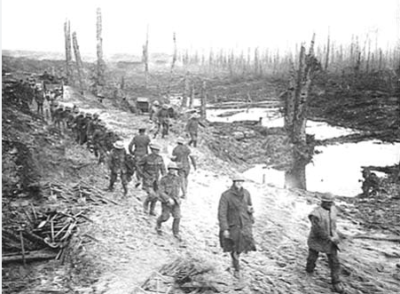 Battle of the Ancre Heights, part of the broader Somme Offensive. Sergeant McLennan was last seen on October 8, 1916, on the first day of the Battle of the Ancre Heights, part of the broader Somme Offensive. After capturing a German trench known as Regina Trench, soldiers fought off at least three German counterattacks before surviving members of the RCR were forced to withdraw. Alone or in small groups, soldiers made their way back to the Canadian line by moving from shell hole to shell hole. Initially reported as wounded and missing, Sergeant McLennan was later officially presumed to have been killed in action.
 Courcelette British Cemetery. Multiple external research reports were submitted to the Directorate of History and Heritage (DHH) and the Commonwealth War Graves Commission (CWGC) regarding a grave in Courcelette British Cemetery. The grave was partially identified as that of “A Serjeant of the Great War Royal Canadian Regt.” Through extensive historical research, DHH confirmed that the grave could only belong to Sergeant McLennan. The identification was confirmed by the Casualty Identification Review Board in December 2025.
The CAF has notified the family of Sergeant McLennan of his identification and is providing them with ongoing support. A headstone rededication ceremony will take place at the CWGC’s Courcelette British Cemetery.
|
|