 By Denis Green By Denis Green
May 27th, 2026
BURLINGTON, ON
Ontario’s regulated online gambling market pulled in $4 billion in gross gaming revenue during 2025. That’s a 34 percent jump over 2024, and it pushed the province’s cumulative haul past $10 billion since the market opened in April 2022. Nearly $98.3 billion in wagers flowed through licensed platforms over those twelve months, which means the average Ontario bettor wasn’t just signing up – they were coming back, week after week, and spending more each time. Three years ago, plenty of analysts doubted whether Ontario’s open-market model could pull revenue away from offshore sites. Those doubts look pretty silly now.
The numbers aren’t slowing down in 2026, either. January alone saw $9.5 billion in total handle, and March topped that with $9.6 billion – a new all-time monthly record. For context, that single month of wagering is roughly equivalent to the annual GDP of a small Caribbean nation. So what’s actually driving this growth? Is it just pent-up demand from years of grey-market gambling? Or has Ontario stumbled onto a regulatory model that other provinces should be copying?

One reason the market keeps expanding is fierce competition among licensed operators. There are now over 50 active platforms chasing Ontario players, and that pressure has forced everyone to improve their product. Faster payouts, better mobile apps, more live dealer tables, localized customer support – it all adds up. Platforms like NorthStar Bets casino have carved out space by focusing specifically on the Canadian player experience, which matters a lot when you’re competing against global brands with massive marketing budgets and decades of European market experience behind them.
Where the $4 Billion Actually Came From
Here’s the thing about Ontario’s revenue split: online casino games, not sports betting, do the heavy lifting. Casino revenue hit $3.15 billion in 2025, accounting for roughly 79 percent of total gross gaming revenue. Sports betting brought in the rest. That ratio surprises people who assume sports is the main draw, but slots and table games generate far more per session than a parlay on the Raptors.
 This logo and the organization behind it have made Ontario a leader in safe gambling. The math is pretty straightforward. Casino players tend to bet more frequently and at higher stakes than sports bettors, and the house edge on most casino products runs higher too. A sports bettor might place three or four wagers over a weekend. Someone playing online slots could run through hundreds of spins in the same time frame. Multiply that by 2.6 million active accounts and you start to see why the casino side dominates the revenue picture so completely.
Player Accounts Keep Climbing
The province reported over 2.6 million active player accounts by the end of 2025’s fiscal year. That’s out of a total adult population of roughly 11.5 million, so about one in four Ontario adults now has an account on at least one regulated platform. Not all of them play regularly, obviously. But the conversion from “created an account” to “actually deposited money” has improved steadily since 2022.
Early on, a lot of people signed up for a promo and never came back. Operators have gotten smarter about retention since then, with loyalty programs and personalized offers that keep players engaged past that first bonus. The average deposit frequency has climbed by about 18 percent year over year, which tells you that operators aren’t just acquiring new customers – they’re actually getting existing ones to stick around longer. That’s a sign of a maturing market.
What Ontario Did Differently
Ontario didn’t follow the American model of awarding a handful of exclusive licenses. Instead, the province opened the door to any operator willing to meet regulatory standards and pay an annual fee of $100,000. That low barrier attracted dozens of companies. The result? Fierce competition and fast innovation.
Ontario’s approach also let the market self-correct. Operators that couldn’t compete on product quality or customer service quietly dropped out, while the strongest ones captured larger market share. Three years in, the model looks like it’s working – revenue keeps rising, player protection complaints have stayed low, and the grey market is shrinking. Compare that to states like New York, where a limited-license approach created a top-heavy market dominated by just a few massive operators. Ontario bet on competition, and the bet paid off.
The Grey Market Problem (and How It’s Shrinking)
Before regulation, Ontario’s online gambling market was essentially the wild west. Offshore sites operated freely, and Canadians had zero protection if something went wrong with a withdrawal or a disputed bet. By late 2025, an estimated 83.7 percent of surveyed players said they used regulated platforms. That’s a massive shift from 2021, when virtually 100 percent of online gambling happened on unregulated sites.
 A stick or a carrot – Ontario regulators are using both. It didn’t happen overnight. It required both carrot and stick – the carrot being better products on licensed sites, the stick being payment processor blocks and advertising restrictions on unlicensed operators. Banks started flagging transactions to offshore gambling sites, making it harder to deposit. At the same time, licensed operators were spending millions on marketing. Point being, the grey market hasn’t vanished entirely, but it’s losing ground fast. That remaining 16 percent is still worth hundreds of millions, though, so there’s work left to do.
How Mobile Changed Everything
If you asked someone in 2019 how they’d gamble online, the answer was probably “on my laptop.” That’s completely flipped. Mobile now accounts for over 70 percent of all sessions on Ontario’s regulated platforms, according to operator reports from late 2025. The shift happened because smartphones got faster, apps got better, and mobile payment options made deposits almost frictionless.
You can go from opening an app to placing a bet in under 30 seconds. That convenience drives volume in a way desktop never could. Think about when people actually gamble – it’s during a commute, on a lunch break, waiting for a friend at a bar. Nobody’s pulling out a laptop in those situations. The mobile-first design of newer platforms has also lowered the barrier for casual players who might never have visited a desktop gambling site but don’t mind tapping through an app for a few minutes. Push notifications help too – a well-timed reminder about a live dealer promotion at 8 PM on a Friday can pull someone back who wasn’t planning to play that evening.
Alberta Is About to Join the Party
Ontario won’t be alone for much longer. Alberta has confirmed a July 13, 2026 launch date for its own regulated iGaming market, with 28 operators already approved. Big names like FanDuel, DraftKings, and BetMGM are on the list. The province’s structure mirrors Ontario in some ways – a dedicated oversight body will manage day-to-day conduct, while a separate commission handles regulation and licensing.
But there are differences. Alberta’s annual licensing fee runs $150,000 per operator, fifty percent higher than Ontario’s. The application fee alone is $50,000. Whether that higher cost scares off smaller operators remains to be seen. Either way, Alberta’s entry roughly doubles the Canadian population covered by regulated private iGaming, from about 15 million in Ontario to around 19.5 million combined. That’s a big deal for operators who’ve been waiting for a second Canadian market to open up.
The Infrastructure Nobody Talks About
Running a regulated iGaming market isn’t just about licensing operators and collecting fees. It requires payment processing networks, identity verification systems, geolocation technology, and server infrastructure that can handle billions in monthly transactions without going down. Ontario’s built much of this from scratch since 2022, and the same challenge faces every province that follows.
 Geolocation alone is surprisingly tricky. Geolocation alone is surprisingly tricky. The system needs to confirm a player is physically inside provincial borders before every single session, and it has to do that without draining the player’s phone battery or creating noticeable lag. Payment processing is another headache – operators need Canadian banking partners willing to handle gambling transactions, and not every bank is eager to get involved. It’s a reminder that digital markets depend on physical systems underneath, not unlike how rural Ontario’s hidden infrastructure challenges show that even basic services rely on networks most people never think about until something breaks.
Tax Revenue and Where It Goes
Ontario charges a 20 percent tax on gross gaming revenue. At $4 billion in 2025 revenue, that works out to about $800 million flowing to provincial coffers. The money goes into general revenue, which funds healthcare, education, and infrastructure projects. That’s a meaningful contribution, though it still pales next to Ontario’s total budget of over $200 billion. The real question is whether these numbers change how other provinces think about regulation – especially as federal transfers tighten and healthcare costs keep climbing. According to Canada’s economic outlook heading into 2026, provinces across the country are scrambling for new revenue sources, and iGaming taxation is starting to look like easy money compared to the political pain of raising income taxes or cutting services.
Alberta’s tax rate hasn’t been finalized yet, but even at a similar 20 percent, the province could reasonably expect $200 to $300 million annually once the market matures. That won’t solve any province’s budget problems on its own, but it’s money that didn’t exist before – and it’s coming from activity that was already happening on unregulated sites where zero tax was collected.
What Comes Next for Ontario’s Market
The easy growth phase is over. Ontario’s market won’t keep expanding at 34 percent annually – there simply aren’t enough new players left to find. The next phase is about squeezing more value from existing customers, which means better retention, higher average deposits, and product innovation like social casino features or gamified loyalty programs.
 Live dealers have become the fastest-growing segment. Live dealer games are already the fastest-growing segment, and operators are investing heavily in Canadian-themed content. Exclusive games featuring Canadian imagery and partnerships with local sports teams are becoming more common. Some operators have even started hiring Canadian dealers for their live streams, which sounds like a small detail but apparently matters to players who want that local feel.
Anyway, the bigger picture is this: Ontario proved that a well-designed regulatory framework can grow the legal market quickly without creating a mess. Alberta watched, learned, and copied the playbook. Quebec, British Columbia, and Saskatchewan are all watching too. Each province will probably tweak the model to fit its own politics and market size, but the core idea – open the market, set clear rules, tax the revenue, and let competition do the rest – looks like it’s here to stay. Give it another two or three years and the patchwork of provincial approaches might start looking a lot more uniform than anyone expected back in 2022.

 By Parker Williams By Parker Williams
March 5th, 2026
BURLINGTON, ON
The Hidden Systems Supporting Rural Living
Across Ontario, conversations about infrastructure often focus on roads, bridges, public transit systems, and municipal water treatment facilities. These are the systems people see and interact with daily. Yet beneath thousands of homes in rural communities lies another critical form of infrastructure that rarely receives attention. Septic systems quietly manage wastewater for properties that are not connected to municipal sewer networks, allowing rural communities to function safely and sustainably.
 They operate underground and silently perform their job every day, which is why they are often forgotten until a problem occurs. For many homeowners outside large cities, these systems are essential. Rural houses, cottages, and small community residences depend on private wastewater systems to collect, treat, and safely dispose of household waste. Without them, wastewater would have nowhere to go, creating serious health and environmental risks.
Despite their importance, these systems remain largely invisible in public discussions about housing and development. They operate underground and silently perform their job every day, which is why they are often forgotten until a problem occurs.
Why Septic Infrastructure Is Often Overlooked
One reason septic systems receive little attention is that they are out of sight. Homeowners naturally focus on visible parts of their property, such as roofs, driveways, and landscaping. Systems buried underground rarely attract attention unless there is a noticeable issue like slow drains, unpleasant odours, or pooling water.
In rural Ontario, many homes were built decades ago, and the septic systems serving them were installed during the original construction. While these systems were designed to last for many years, they require maintenance to function properly over time. Without regular inspection and pumping, solid waste can accumulate inside tanks and gradually reduce the efficiency of the entire system.
Another reason these systems are overlooked is a lack of awareness. Many homeowners simply do not know how septic systems work or how important they are to protecting groundwater and local ecosystems.
The Role Septic Systems Play in Environmental Protection
Septic systems do much more than dispose of wastewater. They are designed to treat household waste before it returns to the surrounding soil. Inside the septic tank, solids settle to the bottom while liquids flow into the drain field, where the soil naturally filters and treats the wastewater.
 Inside the septic tank, solids settle to the bottom while liquids flow into the drain field, where the soil naturally filters and treats the wastewater. This process helps remove harmful bacteria and nutrients before they reach groundwater or nearby waterways. In rural communities that rely on wells for drinking water, this natural treatment process is especially important.
When systems are not maintained properly, however, the environmental consequences can be serious. Wastewater may contaminate groundwater or nearby lakes and streams, affecting both wildlife and local water supplies.
Because of these risks, experts often emphasize the importance of regular maintenance. Professionals working with on-site sewage systems frequently recommend periodic inspections to ensure tanks and drain fields continue operating safely and efficiently.
Growing Pressure on Rural Wastewater Systems
Ontario has experienced significant population growth over the past several years, and many people are moving outside major cities in search of affordable housing or a quieter lifestyle. As rural communities grow, more homes rely on septic systems instead of municipal sewer infrastructure.
Modern homes often use more water than houses built decades ago. Multiple bathrooms, large washing machines, dishwashers, and other appliances can increase daily water usage significantly. When older septic systems are expected to handle higher water volumes than they were originally designed for, the risk of failure increases.
Weather conditions also influence how well septic systems perform. Ontario experiences heavy rainfall, snowmelt in spring, and freezing temperatures during winter. Saturated soil or frozen ground can affect how wastewater moves through the drain field, potentially causing backups or reduced treatment efficiency.
The Financial Impact of Neglected Systems
 Without regular inspection and pumping, solid waste can accumulate inside tanks and gradually reduce the efficiency of the entire system. Ignoring septic maintenance can lead to high costs for homeowners. While routine inspections and pumping are relatively affordable, repairing or replacing a failed system can be expensive. In some cases, major excavation and reconstruction of the drain field may be required.
Beyond the direct repair costs, system failures can also reduce property value. Potential buyers often request septic inspections before purchasing rural homes, and a failing system can delay or complicate real estate transactions.
For homeowners who rely on private wells, contamination risks can also create additional health concerns. Protecting wastewater infrastructure, therefore, protects both property investments and household safety.
Why Education and Awareness Matter
Many people who move from urban areas to rural communities have little experience with septic systems. Municipal sewer networks handle wastewater automatically in cities, so homeowners rarely think about where their wastewater goes.
In rural areas, however, wastewater management becomes the homeowner’s responsibility. Understanding how these systems function is essential for maintaining them properly. Simple habits such as reducing excessive water use, avoiding flushing non-biodegradable materials, and scheduling periodic inspections can extend the life of a system.
Community education also helps protect the broader environment. When homeowners understand how their systems work, they are more likely to maintain them responsibly and reduce the risk of contamination in surrounding water sources.
Looking Ahead for Rural Infrastructure
 Referred to as a single-hole outhouse, there are still a lot of them around the province. As Ontario continues to grow, rural housing development will remain an important part of the province’s housing landscape. Expanding municipal sewer infrastructure to every rural area is not always practical due to geographic distance and infrastructure costs. As a result, septic systems will continue to serve as the primary wastewater treatment solution for many communities.
Recognizing the importance of these systems is essential for long-term sustainability. Local governments, environmental organizations, and homeowners all play a role in ensuring septic infrastructure remains safe and effective.
The systems beneath rural homes may be hidden from view, but their role is essential. By understanding their importance and maintaining them properly, communities across Ontario can continue to rely on this quiet but vital infrastructure for many years to come.
By Gazette Staff
May 22nd, 2026
BURLINGTON, ON
They had to try – NDP introduces motion to delivery grocery price relief to Ontario
Ontario NDP Leader Marit Stiles, held a press conference in Scarborough this morning; where they introduced a bill to scrap the HST on all food and drink, and prevent grocery monopolies from using lease agreements to stifle competitive pricing.
 Marit Stiles: After eight years of Doug Ford, affordability has never been further out of reach. Stiles said: “After eight years of Doug Ford, affordability has never been further out of reach. People are hurting every time they go to pay for their groceries, trying to stretch a dollar further and further just to feed their families.
Our bill calls on Doug Ford to scrap the HST on all food and drink, and ban grocery stores from using lease agreements to prevent competitors from opening nearby, and selling products for less.
“We know it can be done. Wab Kinew’s NDP government in Manitoba has proven we can rein in these wealthy grocery giants and make life more affordable. All it takes is a Premier with the will to act.”
“The Conservatives have already voted against banning surveillance pricing. If they again vote in opposition to making groceries more affordable, they’ll have to explain that to the people of Ontario.”
Bill 113, Fair Prices and Tax-Free Groceries Act, 2026 will be debated in the Ontario Legislature next week.
The unfortunate part is that more than a majority of the people in Ontario seem prepared to live with whatever Doug Ford decides to do.
 By Pepper Parr By Pepper Parr
May 20th, 2026
BURLINGTON, ON
It’s on!
The parade that was the start of the now-defunct Sound of Music event will take place on June 20th at 10:00 am.
 That will mark the opening of the Lakeshore Music & Arts Festival, a free, two-day outdoor celebration taking place June 20–21, 2026, at Burlington’s Spencer Smith Park. That will mark the opening of the Lakeshore Music & Arts Festival, a free, two-day outdoor celebration taking place June 20–21, 2026, at Burlington’s Spencer Smith Park.
Set along the city’s waterfront, the festival will come alive as a vibrant, multi-stage experience featuring nationally celebrated Canadian artists, emerging performers, local artisans, an extensive selection of food trucks, and engaging family-friendly programming. Lakeshore is poised to become one of Ontario’s premier outdoor music and cultural events for years to come.
Local bands, including the Burlington Teen Tour Band and Burlington Junior Redcoats, Top Hat Marching Orchestra, Halton Region Police Service Board Pipes and Drum Band, Crash Rhythm will be featured, along with entries from community organizations.
The parade route will begin near Central Arena on Caroline Street at Drury Lane and continue to Brant Street, ending at Baldwin Street.
 Burlington Teen Tour Band The Burlington Teen Tour Band Boosters will be collecting non-perishable food items and donations for the Burlington Food Bank along the route.
Organized by MRG Live, the festival runs June 20–21, 2026, and will feature more than 30 local and Canadian artists, highlighted by headlining performances from Walk Off the Earth, The Trews, Katie Tupper and The Dirty Nil across a dynamic weekend of live music and arts programming.
The festival is free to attend, with optional paid VIP experiences available.
Having a summer music festival began to look a little iffy when city staff came to the conclusion that the Sound of Music team was not going to be able to hold the event. Most members of Council wanted something to take place and set aside a large sum of money for whoever would put on a festival. MRG Live came out of nowhere with a proposal city staff were stunned with. They moved mountains to make it happen.
Now the public gets to see what MRG is capable of doing. They decided to start with a two-day event (they have a multi-year contract with the city) and decide if they can grow it to become what the Sound of Music used to be.
By Nathan Cole
May 18th, 2026
BURLINGTON, ON
Something’s been happening around Burlington lately. The way people spend money on entertainment has completely shifted in the past year, and I mean really shifted beyond just buying stuff on Amazon.
Last Tuesday my neighbour Mike tells me he’s dropping $87 monthly on streaming services. When I started asking people at that coffee shop on Brant Street about their entertainment budgets, the patterns I noticed were wild. We’re living through a legitimate transformation in how entertainment spending works.
The New Entertainment Economy
People are being way more deliberate now about where entertainment dollars actually go, because you genuinely cannot afford everything anymore with Netflix and Disney+ and sports packages and gaming platforms all competing for the same wallet.
What really grabbed my attention was this buddy mentioning he’d been exploring RexBet Canada for his sports entertainment needs, and then I heard that same platform mentioned by three different people within seven days.
 We’re essentially curating custom entertainment menus at this point. We’re essentially curating custom entertainment menus at this point. Some folks drop $200 monthly on cable without thinking twice. Others pay zero for traditional TV and stream absolutely everything. And plenty of people mix various platforms depending on their mood or what season their favorite show drops.
What I’ve Learned About Digital Entertainment Choices
People around Burlington basically fall into three categories. You’ve got traditional viewers who keep their cable package and add maybe one streaming option. Then the full cord-cutters who went digital years ago and never looked back. And this expanding middle group that experiments constantly with different services.
A guy at my gym walked me through his monthly breakdown. Internet costs him $43. One streaming platform is $19. Sports app runs $25. And he budgets roughly $60 for “variable entertainment spending” that could mean a concert ticket or online gaming or putting money on a Leafs game depending on the month.
Almost everyone I talk to runs some version of this mental calculation now. We’ve all become architects of our own entertainment ecosystems.
Real Numbers From Real People
I did something pretty nerdy recently. Asked 12 people in my circle to track every entertainment dollar for 30 days straight, completely anonymous.
The average landed at $143 monthly. But the spread went from $58 to $287, meaning one person’s entertainment budget was nearly five times another person’s, yet both described feeling satisfied with their value proposition.
Three mentioned betting platforms integrated into their sports viewing habits. Two spent more on video games than streaming subscriptions. One person still maintains an active DVD collection she references weekly.
Zero overlap. Every single entertainment portfolio looked completely different.
Why Burlington Residents Are Changing Habits
You can watch this transformation happening in real time around town. People crave control over their spending. Nobody wants to finance 200 channels when they actively watch maybe 7 programs.
 Seniors have become familiar with the technology and they are now using apps with more ease. But there’s a deeper shift happening too. Digital transactions don’t intimidate us anymore the way they did even five years ago. I watched my 68-year-old father navigate three separate streaming platforms independently. If that demographic can adapt, we’re talking about universal comfort levels.
And residents are treating entertainment as a genuinely flexible budget category now instead of a fixed expense.
Younger Burlington residents especially, the 25 to 45 range, move between platforms with zero hesitation or brand loyalty. They’ll subscribe for eight weeks, cancel, trial something completely different the next month. Just pure value calculation.
Businesses haven’t caught up to how fast this is moving. People want options and flexibility and the feeling that they’re directing where their entertainment money flows instead of being locked into packages designed in 2008.
 By Alan Harrington By Alan Harrington
May 18th, 2026
BURLINGTON, ON
There are probably hundreds, if not thousands of people who don’t fully understand what the holiday we are celebrating this weekend is all about. Alan Harrington tells you why it matters
Victoria Day is the time when we remember the birthday of a Queen who ruled the most powerful country in the world about 200 years ago. Is there anything in town that relates to her?
There is actually: an old green fountain at the City Hall on the corner of Brant and Ontario Streets honours her son, who went on to succeed her as King Edward VII.
Edward VII became King when his mother Queen Victoria died in 1901, and King Edward VII ruled from 1901 to 1910.
 The fountain was manufactured in Hamilton and originally had a horse trough. And the glass ball on top was larger than the one today. The fountain, likely the oldest piece of public art in the city is highlighted in the Burlington Historical Society digital collection and is an important stop on the annual Downtown Heritage Walks conducted during Burlington Heritage Month in February.
The King Edward VII fountain was dedicated 108 years ago, on 2 May 1912 by the Lieutenant Governor of Ontario, Sir John Gibson.
 In the left background is the south elevation of the Trader’s Bank, Brant Street. The carriage on the left conveyed his honour Lieut.-Governor Sir John Gibson, who unveiled the fountain, and Reeve M. C. Smith. The Sons of England float, on the right, carried, clockwise from the centre front: John Bull (represented by Sam Oakes); British soldier (Alf Matthews); Canadian soldier (Charles Rump); Britannia (Jennie Dearing); Miss Canada (Ida Ladle); and Sons of England representative (W. Metcalfe). The parade and dedication ceremony drew people from far and wide.
Those parades were major events in those days.
The fountain was originally located at the foot of Brant Street and Water Street (now Lakeshore) next to what today is the Lakeshore Coffee House.
The Hamilton Spectator reported 4,000 people witnessing the unveiling on the 2nd anniversary of Edward VII’s death.
 The fountain was tucked in between what was then a Royal Bank and the Roxy movie Theatre where there were often long line ups to watch a movie. The fountain was later moved to Spencer Smith park.
The fountain, manufactured in Hamilton, originally had a water trough for horses. The glass ball on top was larger than the one today.
 The fountain after its first restoration with the water troughs in place. The fountain spent a considerable amount of time in storage until it was restored by the Optimist Club of Burlington and relocated to City Hall for the Queen’s Silver Jubilee in 1977
Time once again eroded the features of the fountain. After some encouragement from local concerned citizens, the city agreed the fountain needed work.
 And so, it has been carefully removed and taken to the repair shop. And so, it has been carefully removed and taken to the repair shop.
The four Lion Heads at each corner (for the corners of the earth) match the four lion heads under the City Hall clock. Great Britain was once the most powerful country on earth – it stretched to the four corners of the earth.
As for the man the fountain was created to honour: Edward (Prince Albert) known as Bertie, was in the Golden Horseshoe in 1860 when he visited Toronto and Niagara Falls. He never did get to Burlington.
 Taken away to be restored. The fountain may be small but it stands its ground. It is the oldest public object still on display in the City of Burlington and has been there as our small town has grown to a great city.
But time and weather are hard on such treasures.
 By Norm Coles By Norm Coles
April 25th, 2026
BURLINGTON, ON
Artificial intelligence now plays a central role in online casinos. In Canada, this shift is already visible across many platforms. Two friends who are on the same online casino might not be able to see the same games, offers, or layouts.
Instead, systems adjust content based on their behaviour. This change reflects a move toward data-driven decisions: each action helps shape what appears next.
How Personalization Works in Practice
Everything revolving around personalization starts with tracking user behaviour. Every session provides data, such as game choices, session length, and betting patterns. New systems analyze this information and build profiles that update over time.
 Someone who prefers slots will see slot titles at the top of the page. For example, when a player logs in on Boo Casino in Canada, the system uses this profile to decide what to show first. Someone who prefers slots will see slot titles at the top of the page. A user who spends more time on blackjack may see table games instead. The goal is to reduce the time spent searching and make navigation more direct.
Smarter Game Recommendations and Bonuses
Games are the easiest place to see how this works. When a player moves between certain types of games, the system starts picking up on that pattern and suggests similar titles. Over time, those suggestions become more accurate because the system keeps learning from each session rather than relying on fixed settings.
Bonuses work in much the same way. Platforms no longer send the same offer to everyone. Instead, they adjust promotions based on how often someone plays and how they use the site. A regular player may see a different bonus than someone who logs in less often.
 If activity drops, the system can react by showing an offer at that moment. This helps avoid sending promotions that go unused and puts more focus on players who are likely to respond. Timing plays a part as well. If activity drops, the system can react by showing an offer at that moment. This helps avoid sending promotions that go unused and puts more focus on players who are likely to respond.
The Era of Evolving Interfaces
Personalization also changes how people move around a casino site. The layout isn’t always fixed. Sections that get used more often tend to stay easy to find, while parts that are ignored may drop lower on the page. It’s not something most users notice right away, but it does make the site easier to use over time.
Some platforms go a step further and test different layouts with different groups of users. One group might see a slightly different version than another. The operator then looks at what works better and adjusts the design based on those results. Over time, the structure shifts instead of staying the same.
The Improvement of Responsible Gambling Tools
Another key area is player protection. Sure, loss limits and self-assessment tests are useful, but AI really has the power to drastically reduce gambling addiction if used correctly. How? To put it simply, it can monitor activity in real time and thus notice strange patterns.
For example, sudden increases in deposits or longer sessions may trigger alerts. It might mean that a player is chasing his or her losses, playing more and more to recover from some unlucky bets. This behaviour is often the first sign of gambling addiction.
Manual checks would take much longer to identify this compared to AI. What next, though? Once a pattern is detected, the platform can respond and send reminders, suggest limits, or restrict certain actions.
What This Means for Canadian Operators
 Once a pattern is detected, the platform can respond and send reminders, suggest limits, or restrict certain actions. For operators, personalization has clear advantages. It improves retention and makes marketing more efficient. Instead of broad campaigns, platforms can target smaller groups with more relevant offers.
This approach also reduces costs. Resources are used where they are more likely to have an effect. As a result, personalization has become part of standard operations rather than an optional feature.
In Canada, where the online casino market continues to grow, this trend is likely to expand. At the same time, regulation plays a role, and authorities are paying closer attention to data use, fairness, and player protection.
Looking Ahead
In simple terms, personalization has changed how online casinos operate in Canada. It affects what players see, how they interact with platforms, and how offers are delivered. This shift is still in progress, but it is already part of how the industry works today.
And of course, it’s not over yet. Future tools may respond even faster, and predictive models will likely become more accurate. At the same time, expectations will necessarily change. Players will expect platforms to be clear about how they use their data, and transparency will matter even more than now.
By Søren Frichs
March 24th, 2026
BURLINGTON, ON
The Rise of Digital Transformation in Local Communities
Homeowners associations (HOAs) have long been the cornerstone of neighbourhood governance, balancing residents’ needs with the realities of managing communal resources. In recent years, digital tools have revolutionized this sector by streamlining administrative tasks, enhancing communication, and fostering community engagement. Across many communities, local boards are now leveraging technology to facilitate transparent financial reporting, schedule maintenance, and even host virtual meetings. For those interested in the evolving nature of HOA community management, this digital wave represents not just a technological upgrade, but a complete transformation in how neighbourhoods operate.
The challenges faced by traditional associations—from cumbersome record-keeping to slower decision-making processes—have driven many boards to invest in new systems. Digital solutions simplify routine operations and empower homeowners with real-time access to information. Whether it’s tracking community budgets or streamlining service requests, these innovations are enhancing operational efficiency and building trust among residents.
Integrating Innovative Technologies for Enhanced HOA Operations
 The challenges faced by traditional associations—from cumbersome record-keeping to slower decision-making processes—have driven many boards to invest in new systems. As digital tools become a staple in community management, HOAs are increasingly exploring integrated solutions that merge administrative tasks with engagement options. Boards that once relied on paper records and face-to-face meetings are now embracing comprehensive software that provides dashboards for financial management, event planning, and even online voting.
Beyond civic tools, digital entertainment has also become part of how many Canadians spend their downtime at home. Online gaming platforms and casino guides have seen significant growth in recent years, with residents increasingly turning to resources like the Valencia Bonita HOA guide to explore their options. As internet access improves and digital literacy grows, more Canadians are comfortable navigating these platforms from the comfort of their own homes.
The adoption of digital tools for HOA management has led to significant improvements in transparency and accountability. For example, many associations now offer residents secure online portals where they can view governing documents, meeting minutes, and financial reports. These systems not only reduce administrative delays but also allow members to provide feedback and participate more actively. As communities become increasingly tech-savvy, focus is shifting from reactive problem-solving to proactive planning—a move that bodes well for long-term community development.
Benefits of Digital Tools for Traditional HOAs
The integration of digital tools into HOA operations is yielding numerous benefits. One of the most significant improvements is the acceleration of decision-making processes. With real-time data readily available, boards can quickly assess budgetary concerns, monitor compliance issues, and schedule maintenance before problems escalate.
Furthermore, digital tools have broadened the communication channels between board members and homeowners. Systems that support instant messaging, surveys, and virtual town hall meetings are fostering a more engaged and informed community. This enhanced interaction not only boosts resident satisfaction but also facilitates more efficient dispute resolution.
In addition to more efficient management, digital systems play a pivotal role in ensuring regulatory compliance. Increasingly stringent requirements from state and federal authorities demand that HOAs provide transparent, accessible records. By automating document management and communications, associations are better equipped to meet these standards while reducing the administrative burden on board members.
Research indicates that digital platforms can reduce process times and improve transparency in financial operations; a report by Deloitte’s Digital Transformation Insights underscores these benefits and reinforces the case for digital adoption in community management.
Overcoming Challenges in the Digital Transition
Despite the apparent advantages, embracing digital tools is not without challenges. Many HOAs face hurdles such as limited budgets, resistance to change among long-standing board members, or concerns over the security of online systems. These obstacles must be addressed carefully to ensure a smooth transition from traditional methods to digital solutions.
 Comprehensive training and educational programs for board members are essential in this transition. By partnering with technology and digital management experts, HOAs can gradually introduce new systems and ensure that all stakeholders become comfortable with them. Moreover, providing clear guidelines and protocols around data security can mitigate concerns regarding cyber threats. A McKinsey article on leadership and digital transformation offers practical strategies to help community associations navigate these challenges successfully: McKinsey’s Leadership and Digital Transformation Insights. Comprehensive training and educational programs for board members are essential in this transition. By partnering with technology and digital management experts, HOAs can gradually introduce new systems and ensure that all stakeholders become comfortable with them. Moreover, providing clear guidelines and protocols around data security can mitigate concerns regarding cyber threats. A McKinsey article on leadership and digital transformation offers practical strategies to help community associations navigate these challenges successfully: McKinsey’s Leadership and Digital Transformation Insights.
In many cases, small-scale pilot projects have proven effective in demonstrating the long-term benefits of digital tools. These initiatives allow HOAs to test the waters, adjust systems based on feedback, and gradually scale up implementation. This careful approach minimizes disruption and builds confidence among homeowners, ensuring that the move to digital management is both inclusive and well-supported.
Community Impact and Looking Towards the Future
The most transformative aspect of embracing digital tools in HOA community management lies in the empowerment of residents. With user-friendly online systems, homeowners have greater opportunities to be involved in decision-making. The transparency fostered by digital management leads to more collaborative relationships between board members and residents.
As communities experience increased engagement, local governments and community news outlets are recognizing these trends. An examination of community updates from the Burlington Gazette community updates illustrates how technology is beginning to influence even the most traditional areas of civic life.
Looking forward, the integration of advanced digital tools such as artificial intelligence and predictive analytics holds remarkable potential for the future of HOA management. By harnessing these sophisticated technologies, associations can forecast maintenance needs, optimize energy consumption, and customize services to better suit individual community requirements. This evolution will inevitably lead to smarter, more sustainable communities well-prepared to tackle future challenges.
Moreover, as regulatory pressures continue to evolve, HOAs that proactively adopt digital solutions will be better positioned to comply with new guidelines. This proactive approach not only fosters greater accountability but also creates a resilient framework capable of adapting to a rapidly changing technological landscape.
Conclusion: Transforming the Fabric of Neighbourhood Management
The shift towards digital tools for HOA management is more than a mere trend—it is a necessary evolution reflecting the growing expectations of today’s homeowners. Through streamlined operations, enhanced communication, and robust security measures, digital transformation is helping communities not only to survive but thrive in an increasingly digital world.
 By addressing challenges through targeted education and strategic implementation, HOAs pave the way for enhanced community involvement and better-managed neighbourhoods. By addressing challenges through targeted education and strategic implementation, HOAs pave the way for enhanced community involvement and better-managed neighbourhoods. As innovative solutions continue to emerge, the future of community management looks promising. Digital transformation is forging stronger, more transparent partnerships between residents and board members, ensuring that every neighbourhood benefits from the efficiencies of modern technology.
In this dynamic era, communities willing to invest in digital tools are setting new standards for governance. The thoughtful integration of technology secures not only operational improvements but also fosters trust and inclusivity among residents. With ongoing advancements, HOA management is poised to become a model for effective, future-ready community governance.
 By Tom Parkin By Tom Parkin
March 23rd, 2026
BURLINGTON, ON
Will the coming price shock be contained to fuel costs? Or “leak” into other products, maybe bringing damaging Bank of Canada rate hikes?
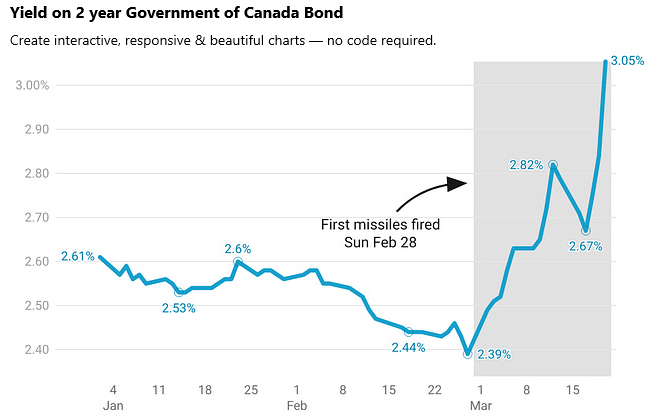
War, what is it good for?
Not the price of bonds, and that’s a prediction of job losses for Canadian workers unless the coming wave of inflation can be contained, or at least contained just to oil prices.
A deep drop in the price of Government of Canada two year bonds drove yields way up last week, Bank of Canada data shows. The two-year bond is considered a strong predictor of where traders think the Bank’s key rate is headed.
Data from the London Stock Exchange Group now points to a 75 basis point increase to the central bank’s key overnight rate, rising from its current 2.25 per cent to 3.00 per cent by year end. But the LSEG data still only assigns a 20 per cent chance the Bank of Canada will start this rate increase next month.
Interest rate hikes would kill jobs at a dangerous time
Interest rate hikes add costs for households and businesses that hold loans, shrinking the money available for purchasing and investment. Their entire point is to cut aggregate demand by killing growth and jobs.
Heck of a way to run an economy.
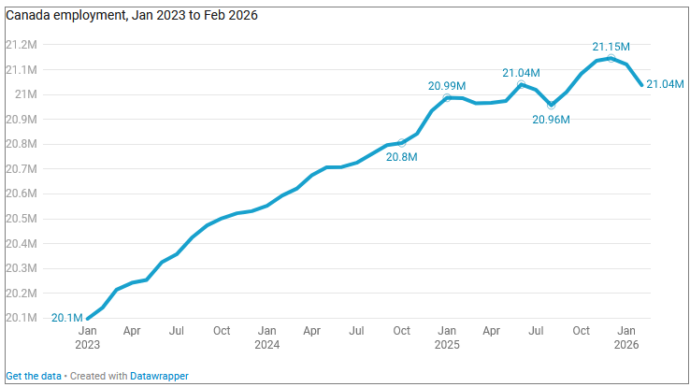
It’s always damaging. And this timing is terrible. StatsCan’s Labour Force Survey for February shows Canada lost 110,000 jobs since December. The country is under an attack of “economic force” from Donald Trump as he attempts to deindustrialize us. And though some provinces and the federal government are fighting back with a major projects agenda, and the Carney government deploys defence Keynesianism, those shifts will not deliver in the short-term.
On the other hand, higher interest costs will start inflicting economic damage almost immediately.
Interest rate hikes can kill jobs but can’t create oil
The possibility of rate hikes arises from the attacks on oil production facilities in Iran, Kuwait, UAE, Saudi and Bahrain, and on tankers in the Persian Gulf, have pushed up the global price of oil.
Though the fuel Canadians buy today was probably refined from crude before the war, prices at the pump are already way up.
The price hike is driven by a supply shortage. But hiking interest rates will do nothing to create more oil and therefore will be ineffective at pushing down oil prices.
U.S. Federal Reserve Chairman Jerome Powell said his central bank might be able to “look through” the fuel price hikes, accepting the impact, which would be a hard hit, but just one-time. However, Powell expressed concern fuel price hikes might “leak” into other areas. It’s those other price increases that can be affected by turning down economic growth using rate hikes.
This time, can oil inflation be contained?
The previous wave of inflation took off when sanctions on Russia over its attack on Ukraine hiked oil prices. It was pushed higher by interrupted production of key products, like computer chips, and supply chain break-downs, particularly trans-pacific shipping.
But cost increases were not contained to those items. As work by Canadian economist D.T. Cochrane shows, domestic companies used the opportunity of external price shocks to add to their mark-ups, spreading inflation. The Bank of Canada originally believed inflation was “transitory.” But when it clearly had been allowed to become generalized the Bank pushed up rates, with the predicable damaging results.
To the degree Canadian governments can moderate an oil price surge or contain it —by prevent businesses from taking the opportunity to hike prices — the Bank’s intervention will be less. And the damage to Canada at this dangerous time will be less.
It should be a priority of governments to arm themselves with tools to prevent inflation’s “leak,” which will hurt the spending power and the jobs of Canadian workers at a time they are already under attack from out enemy in the White House.
 By Gazette Staff By Gazette Staff
March 19th, 2026
BURLINGTON, ON
 A new Fraser Institute study shows that combined federal, provincial, and municipal government spending now equals 43.6% of Canada’s entire economy – and the size of government (as a share of GDP) has grown in all ten provinces since 2019. A new Fraser Institute study shows that combined federal, provincial, and municipal government spending now equals 43.6% of Canada’s entire economy – and the size of government (as a share of GDP) has grown in all ten provinces since 2019.
In 2024, it ranged from a low of 30.4% in Alberta to a high of 61.2% in Nova Scotia.
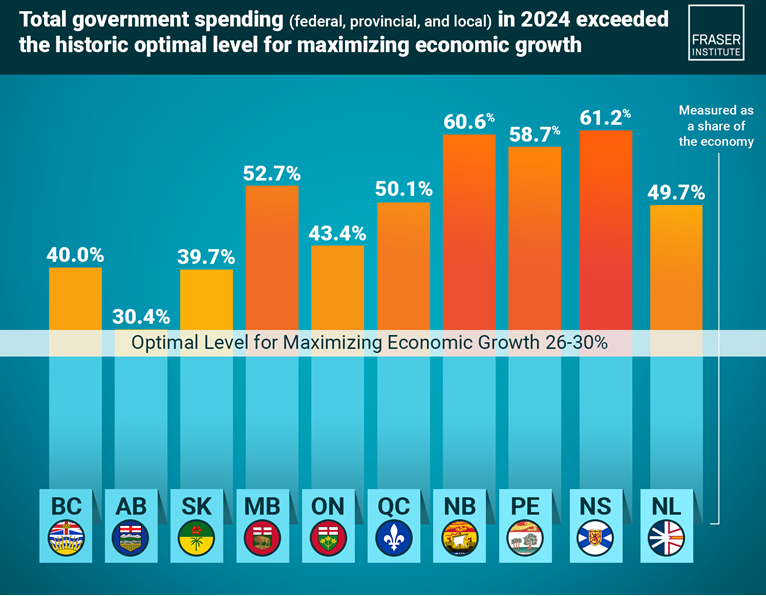
Research indicates the optimal government size for maximizing economic growth and social progress is 26–30% of GDP – meaning every province is now above that level, with some more than double the ideal.
Larger government can crowd out private investment and slow economic growth without delivering proportional benefits. The trend points to governments taking up more of the economy in recent years, with potential long-term impacts on prosperity.
Read the full study here to see how your province stacks up – and share it with friends, colleagues, or policymakers!
Focus Burlington can be expected to issue a statement: “Told you so!”
 By Frank Conselleri By Frank Conselleri
March 18th, 2026
BURLINGTON, ON
Every February, millions of people around the world tune in for what is arguably the most-watched sporting event on the planet: the Super Bowl. What began as a championship game between two American football leagues has evolved into a global cultural moment that blends sport, entertainment, advertising, and community in a way no other event quite manages.
 Strength and strategy. While the NFL season stretches across several months, the Super Bowl has a gravitational pull all its own. Even casual fans who rarely follow regular-season games find themselves drawn in by the spectacle — the halftime show, the commercials, the celebrity appearances, and the sense that something bigger than sport is unfolding.
More Than a Game
At its core, the Super Bowl is a championship contest between the best teams in the National Football League. But over time, it has become a reflection of American pop culture. Advertisers spend millions of dollars for 30-second slots, musicians treat halftime performances as career-defining moments, and households across North America organize parties that rival major holidays in scale.
In Canada, interest in the NFL has grown steadily over the past two decades. Television ratings continue to climb, merchandise sales remain strong, and fantasy football leagues have helped introduce new audiences to the strategic depth of the game. The Super Bowl, in particular, has become an annual appointment viewing event, even for those who may not watch football the rest of the year.
The Rise of Data, Strategy, and Analysis
One of the reasons American football has aged so well in the digital era is its adaptability to data and analysis. Advanced metrics now influence everything from draft decisions to in-game play calling. Fans consume statistics, predictions, and breakdowns at an unprecedented rate, often engaging with the sport on a deeper level than ever before.
This analytical approach has also shaped how people follow the Super Bowl. Discussions around matchups, player performance, and historical trends dominate conversations in the weeks leading up to kickoff. Whether it’s debating quarterback efficiency or defensive matchups, the modern fan approaches the game with more information at their fingertips than any previous generation.
 It is no longer just a game – it is an economic engine enjoyed around the world. The Entertainment Economy of the Super Bowl
Beyond the action on the field, the Super Bowl has become an economic engine. Cities compete fiercely for the right to host the game, knowing it brings tourism, media attention, and long-term brand value. Hotels fill months in advance, restaurants prepare for record traffic, and local businesses see a measurable boost.
Then there’s the advertising phenomenon. Super Bowl commercials have become cultural artifacts in their own right, often released online days before the game and dissected across social media platforms. For many viewers, the ads are just as anticipated as the final score.
The Growing Role of Fan Engagement
 It was a great match-up – the Seahawks against the Patriot. As digital platforms evolve, so too does the way fans engage with the Super Bowl. Social media commentary, live stats, and second-screen experiences have become part of the ritual. Viewers now watch with phones or tablets in hand, tracking plays, sharing reactions, and participating in real-time discussions.
This shift has also contributed to the growing interest in predictive engagement around the game. Many fans enjoy testing their knowledge of teams and players by exploring odds, matchups, and outcomes ahead of kickoff. For those interested in this side of the experience, betting sites offering Super Bowl Betting options provide a structured way to engage with the sport while following the action play by play.
Why the Super Bowl Resonates Year After Year
What makes the Super Bowl endure is its ability to evolve while staying rooted in tradition. The rules of the game remain familiar, but the presentation, technology, and storytelling continue to change. Each year brings new stars, new narratives, and new moments that quickly become part of sports folklore.
For many fans, the Super Bowl is also about connection — gathering with friends, sharing food, debating calls, and celebrating or commiserating together. In an increasingly digital world, it remains one of the few events that reliably brings people together in real time.
Looking Ahead
 The Super Bowl – America’s game, shared with the world. As the NFL continues to expand its international reach, the Super Bowl’s influence will only grow. Games played overseas, streaming partnerships, and global fan engagement point to a future where American football becomes even more embedded in the worldwide sports landscape.
Yet no matter how much the spectacle grows, the essence remains the same: two teams, one championship, and a few unforgettable hours that capture the attention of millions. Whether you’re watching for athletic excellence, the halftime show, or the shared experience, the Super Bowl continues to stand alone as one of sport’s most compelling annual events.
By Norm Coles
March 18th, 2026
BURLINGTON, ON
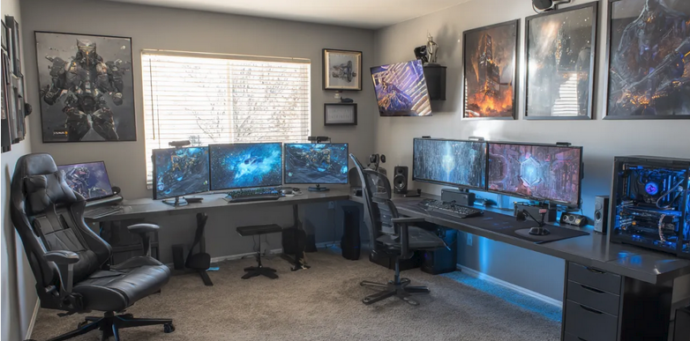 Gamers have dreams of the ultimate Game Room. They can be quite complex.
Gaming in Canada looks very different from how it did even a decade ago. The core idea remains familiar. People still enjoy games as a way to relax or simply have some fun in their spare time. What has changed is how and where those games are played. Technology has reshaped habits gradually. Many Canadians now interact with games in ways that would have felt unusual not long ago.
The shift is not limited to one type of gaming either. Different forms of gaming platforms form a landscape where choice is broader and access is easier than ever.
The Growing Variety Of Casino Games
Casino gaming has become one of the most visible examples of changing habits. In the past, these games were tied closely to physical venues. Visiting a casino meant planning a trip and spending time in a particular location.
A large portion of that activity now happens online. Canadian players can explore hundreds of games through digital platforms that run on tablets and phones. This shift opened the door to far more variety than traditional venues could ever provide. There are hundreds of different games at online casino brands. A look through the Sportaza online casino game selection shows that both table and slot games have grown. There are also live casino games that provide a different way to play.
Slots remain one of the most common options, partly because developers release new versions constantly. Themes change while visual styles become more elaborate with each new title. Table games such as blackjack and roulette also appear in many forms. There are classic digital versions as well as live dealer formats where real tables are streamed online.
This variety means players can explore different styles of play without leaving home. One evening might involve a quick session of slots. Another might focus on a slower table game. The choice is wide – that flexibility has made casino gaming more accessible to a larger audience.
Mobile Gaming And The Power Of Better Internet
One of the biggest reasons gaming habits are changing is simple: faster internet and better mobile devices. Smartphones now run games that once required a full computer or console setup. Canada has been improving both mobile and fixed internet speeds consistently.
Mobile platforms encourage an on-the-go style of play because games are designed to start quickly and save progress automatically.
 Network improvements across the country have definitely helped. Stronger connections mean games load faster and run more smoothly. It is also relatively affordable to get decent internet in Canada. Multiplayer sessions can happen without long delays, which makes the experience feel more social and responsive. Network improvements across the country have definitely helped. Stronger connections mean games load faster and run more smoothly. It is also relatively affordable to get decent internet in Canada. Multiplayer sessions can happen without long delays, which makes the experience feel more social and responsive.
The rise of mobile gaming has also influenced how developers design new titles. Many games are now created with smaller screens in mind first. Games like Fortnite also led the way in terms of cross-platform gaming. It means that the device is less crucial to compatibility. Lots of top titles have embraced cross-platform play.
Console Gaming Still Holds A Strong Place
Even with the growth of mobile play, console gaming remains a huge part of the Canadian gaming culture. It seems likely this will always have its part in the gaming landscape. Large story-driven titles continue to attract players who enjoy long sessions and immersive worlds.
Modern consoles connect easily to online services. This allows players to download games directly instead of buying physical copies. Updates arrive automatically – new content appears regularly through expansions or seasonal events.
This constant flow of updates keeps games active long after their release. Communities form around them to share strategies and highlights through streaming platforms and social media sites like X and Instagram.
Online Communities And Streaming Culture
 Gaming has come a long way from the simple pixelated screens of the past to the immersive, lifelike experiences of today. It has grown into a cultural phenomenon, influencing art, technology, and even social interaction. What once started as a hobby for a niche audience has now become a mainstream form of entertainment embraced by millions worldwide. Another noticeable change involves how players interact with each other. Gaming used to be mostly private or limited to small groups of friends. Online communities now bring thousands of players together.
Streaming platforms like Twitch and YouTube Live allow audiences to watch others play in real time. Commentary and strategy discussions happen alongside the gameplay itself. This creates a shared culture around certain games and personalities.
Canadian players participate in these spaces just as actively as anyone else. Viewers watch tournaments and discuss updates or strategies in community forums.
The result is a gaming environment that feels far more connected than before. This is similar to how many forms of gaming have worked and evolved – they are simply way more accessible.
A Future With Even More Choice
It seems that gaming will continue to expand in multiple directions at once. Mobile platforms will grow stronger. Online communities will remain active. Console titles will push visual and storytelling boundaries.
The biggest recent change is not the games themselves but the freedom to choose how they engage with them. A single device can host dozens of options. Sessions can last hours or just a few minutes. It all comes down to personal preference.
By Gazette Staff
Mar 17, 2026
BURLINGTON, ON
Legal action follows public health warning about infection control practices at Burlington clinic
Diamond and Diamond Lawyers have filed a $5 million lawsuit in the Ontario Superior Court of Justice on behalf of Burlington resident Darwin Allen, who allegedly contracted Hepatitis C after being injected with an unsterile needle during treatment at the Halton Family Health Centre Walk-In Clinic.
The lawsuit names Halton Family Health Centre Inc. and Dr. Timothy Salter as defendants and alleges negligence, vicarious liability and breach of fiduciary duty.
According to the Statement of Claim, Mr. Allen attended the clinic in September 2023 after suffering a cut to his heel. During treatment, Dr. Salter allegedly injected him with lidocaine using an unsterile needle.
 In November 2025, Mr. Allen received a letter from Halton Region Public Health advising that improper infection prevention and control practices involving the use of unsterile needles with multidose vials of anesthetic medication had been identified at the clinic. The letter advised him to consult his healthcare provider and undergo testing for Hepatitis B, Hepatitis C and HIV. In November 2025, Mr. Allen received a letter from Halton Region Public Health advising that improper infection prevention and control practices involving the use of unsterile needles with multidose vials of anesthetic medication had been identified at the clinic. The letter advised him to consult his healthcare provider and undergo testing for Hepatitis B, Hepatitis C and HIV.
Shortly thereafter, Mr. Allen underwent a Hepatitis C blood test. In December 2025, he was notified that he had tested positive for Hepatitis C.
“No patient should walk into a clinic for routine treatment and leave with a life-altering infection,” said Darryl Singer of Diamond and Diamond Lawyers. “This case is about accountability and ensuring proper medical standards are followed.”
 The lawsuit alleges the defendants breached their duty of care by failing to implement appropriate infection prevention and control measures and failing to ensure needles used in treatment were properly sterilized. The lawsuit also alleges Halton Family Health Centre Inc. is vicariously liable for the conduct of Dr. Salter. The lawsuit alleges the defendants breached their duty of care by failing to implement appropriate infection prevention and control measures and failing to ensure needles used in treatment were properly sterilized. The lawsuit also alleges Halton Family Health Centre Inc. is vicariously liable for the conduct of Dr. Salter.
Diamond and Diamond Lawyers believe Mr. Allen may not be the only patient affected. Individuals treated at the Halton Family Health Centre Walk-In Clinic who later received a public health notice, or who have concerns about their care, are encouraged to contact the firm.
Diamond and Diamond Lawyers is a Canadian personal injury and medical negligence law firm that has recovered over a billion dollars in settlements for injured Canadians.
Related news story:
Resident found that he was infected after attending a clinic that had used needles that were not properly sterilized
 By Serena Sirb By Serena Sirb
March 17th, 2026
BURLINGTON, ON
As spring arrives in Burlington, residents are seeking ways to take their fitness outdoors while also staying safe. This has led to a rise in community fitness programs leveraging secure online platforms for group challenges and virtual coaching.
Digital tools can provide structured group engagement. They can also provide encrypted progress logs and privacy-focused data handling through user-friendly interfaces. These tools are great for those looking to make the most of the warmer months and longer days.
Entertainment Apps and the Rise of Secure Digital Platforms
 There is nothing more exhilarating than a spring run outdoors. Beyond fitness, digital entertainment apps have also remained popular as residents transition into spring. This includes streaming services, multiplayer games and even casino platforms. While they can’t be classed as fitness apps, they’ve helped set expectations for smooth interfaces, strong account protection and reliable payment systems. In terms of iGaming, an online Pokertube review provides insight into how casino platforms manage user safety, encryption and responsible account features.
Fitness app developers are borrowing ideas from this type of entertainment platforms that successfully keep users engaged while also protecting personal information. New features like secure logins and community leaderboards mirror systems that entertainment apps already have.
Spring Fitness Apps: Secure, Structured and Effective
Many Burlington residents are now looking to complement local fitness programs with spring fitness apps. These apps provide safe and structured ways to stay active both indoors and outdoors. These platforms combine secure account management, community accountability and guided workout plans that help users maintain consistency as they build on the habits established over winter.
Safety and Privacy Features
 Many apps now prioritize digital security. As we already discussed, these mirror the standards seen in online entertainment and gaming platforms. Leading apps like Strava, MyFitnessPal and Fitbit offer features such as encrypted progress logs to protect user activity data. Many apps now prioritize digital security. As we already discussed, these mirror the standards seen in online entertainment and gaming platforms. Leading apps like Strava, MyFitnessPal and Fitbit offer features such as encrypted progress logs to protect user activity data.
Plus, two-factor authentication features ensure secure logins and compliance with Canada’s PIPEDA privacy regulations. These safeguards ensure that personal metrics, location data and health information remain confidential. This gives users peace of mind while engaging in virtual and outdoor fitness challenges.
The prices of these apps vary, with free versions available. However, getting a premium version of one of these apps ensures better data, as well as more enhanced safety and privacy features. To give you an idea of premium pricing, Strava Premium is $14.99 CAD per month.
Structured Weekly Plans and Progress Tracking
Apps like Nike Training Club and Runkeeper provide structured workout plans with clear progression schedules. Weekly check-ins and guided programs encourage disciplined pacing. This is similar to what local group challenges promote. Users can track incremental improvements in endurance or flexibility. They can then adjust workouts as needed. For example, research shows that consistent adherence to structured training programs can lead to measurable health gains, such as up to a 15.10% improvement in VO₂ max over a 10-week period. This highlights the real-world return on investment in terms of cardiovascular fitness.
Tailored Outdoor and Home Workouts for Spring
 Yoga classes take place in parks and in Civic Square in Burlington. Apps like Down Dog offer customizable yoga and mobility sessions for those training both indoors and in the park. Fitbit and Runkeeper are also good for tracking performance metrics such as your heart rate. They’re also great at keeping track of step counts and distance — particularly useful as warmer temperatures make running and cycling along Burlington’s waterfront and trails more appealing. With this advanced data, you can combine data-driven insights with guided routines to monitor health gains. You can then use the data to optimize workout intensity. Overall, this allows you to build consistent spring fitness habits.
These apps illustrate how secure and socially engaging platforms can complement Burlington’s spring fitness initiatives. Residents can feel empowered to stay active safely thanks to the privacy protection, goal tracking and measurable results features offered. They can also track progress and see tangible improvements in health. Such insights can prove to be a huge boost for stamina and commitment to exercise as the days grow longer and the weather improves.
Integrating Wearables and Smart Devices
 Once connected, customizable yoga and mobility sessions for those training both indoors and in the park. This spring, many Burlington residents are also using wearable devices to enhance their fitness sessions. Most commonly, devices like Fitbit, Apple Watch and Garmin trackers keep users in the know about key health metrics. This includes heart rate, step counts, active minutes and even VO₂ max estimates.
These devices can be connected with the apps we mentioned before. Once connected, customizable yoga and mobility sessions for those training both indoors and in the park. and stay accountable to their fitness goals.
Staying Both Safe and Active in Spring
Based on local sporting news, there are many sports events and outdoor activities that pick up through the spring season. As the season continues, Burlington residents can leverage these tools to maintain consistency and track measurable gains. They can also use them to participate in a growing culture of safe, low-risk, digitally enabled sports activities.
Whether through municipal programs, outdoor group runs or hybrid virtual challenges, spring in Burlington has become an opportunity to stay active, healthy and connected — enjoying the season’s milder weather and renewed energy. Residents can combine these events with premium fitness apps and enjoy guided workouts, progress tracking and community accountability, while making the most of everything the season has to offer.
By Gazette Staff
March 16th, 2026
BURLINGTON, ON
Chinese EV’s are coming to Canada.
The federal government has a deal with the Chinese government that permits China to sell 49,000 EV’s in Canada each year.
News earlier today has Lotus, the British sports car brand that currently sells just one model at low volume in Canada, is aiming to be among the first companies to sell Chinese-made electric vehicles in this country under the federal government’s new import quota system.
 Lotus Eletre, a battery-powered “Hyper SUV” made in Wuhan, China. It is already listed on dealer websites and is expected to land in Canadian showrooms in the third quarter of 2026 The brand, known as a cult-favourite maker of lightweight performance cars, is now under the umbrella of Chinese giant Geely, which also owns Volvo and Polestar.
The car it is hoping to start shipping to Canada is the Lotus Eletre, a battery-powered “Hyper SUV” made in Wuhan, China. It is already listed on dealer websites and is expected to land in Canadian showrooms in the third quarter of 2026, according to Massimiliano Trantini, president and chief executive officer of Lotus Cars Americas.
“Our Eletre is already homologated [meets road worthiness standards] for Canada and we will be hosting our official launch event very soon,” Mr. Trantini said in an e-mail to The Globe and Mail.
The price will likely be well into six-figure territory. The vehicle will have a cabin lined with leather from Scottish tannery Bridge of Weir, and up to 905 horsepower. The Lotus Eletre is not – to state the obvious – one of the affordable new Chinese EVs many Canadians were hoping to see after the federal government announced lower tariffs and a new quota system.
Part of the rationale for slashing tariffs was that it would boost the availability of affordable EVs. By 2030, the government says, about 70,000 Chinese-made EVs will be imported under the new quota system and half will need to have an import price of $35,000 or less.
Unlike other cars the brand makes, the Lotus Eletre all-electric SUV is neither lightweight nor low-power.
The company has six dealers across Canada, with plans to add more. “Our plan is to grow the dealer network in line with demand, which we expect to increase rapidly following our market entry,” Mr. Trantini added.
The Eletre may be a tough sell in Canada. Sales of EVs dropped significantly last year and there are already a wide range of high-priced luxury electric SUVs on offer from other brands including the likes of BMW, Mercedes-Benz, Audi, Rivian, Tesla, Volvo, Porsche and Cadillac.
By Frederick Oostram
March 15th, 2026
BURLINGTON, ON
Players often wonder whether every spin or deal represents a fair experience, and this curiosity leads to frequent questions about Glorion in particular. Behind many digital casino games, a random number generator (RNG) helps determine outcomes in line with the game’s programmed rules. Understanding how RNG testing works offers useful context for evaluating fairness at Glorion Casino, whether on slots, cards, or other digital games.
 Each outcome is generated independently of previous rounds. In online gambling, “randomness” is a technical claim rather than a marketing slogan. For many game types, the outcome is produced by software, not by physical cards, dice, or wheels. That makes the quality of the RNG, and the way it is tested, central to whether results behave as intended over time. The sections below outline what RNGs do, how testing is typically approached, and where players most often encounter RNG-driven outcomes in Glorion Casino environments.
Why randomness matters in digital casino games
Randomness is the baseline requirement for outcomes to be unpredictable from one round to the next. If results could be anticipated or influenced through patterns, timing, or player behaviour, the game’s stated odds would no longer describe what actually happens during play. For that reason, digital casino products like those at Glorion Casino are usually designed so each outcome is generated independently of previous rounds.
In practical terms, independence means a prior win or loss does not make the next outcome more or less likely. It also means the game’s behaviour should be consistent across devices and sessions, within the limits of its programmed probabilities. When players assess fairness at Glorion Casino, this concept of independence is often at the centre of their questions about how games behave.
What an RNG is and what it does in play
An RNG is software that produces numbers used to select outcomes, such as where a slot reel stops or which virtual card is dealt next. Most modern systems rely on a pseudo-random number generator, which uses algorithms to create sequences that aim to be statistically indistinguishable from true randomness for gaming purposes. The RNG’s output is then translated into game events according to the rules embedded in the game’s code.
An RNG is not intended to adjust results based on a person’s identity, past activity, or the size of a wager. Instead, the key design goal is that each game round draws from the same probability model every time it is played. Discussions about RNG fairness often focus on whether the generator behaves consistently with these principles and whether testing supports that expectation.
How RNG testing is typically approached
 When players consider fairness questions about the practical issue is not only whether numbers are generated, but whether the whole chain, from generated values to displayed outcomes, operates as designed. RNG testing generally focuses on whether outcomes meet expected statistical properties, such as uniformity and independence. In broad terms, that can involve analyzing large samples of generated numbers to check for biases or patterns that should not exist in a well-functioning system. Testing may also include verifying that the RNG implementation matches its specification and that changes to software do not introduce unintended effects.
Another focus is mapping, confirming that RNG outputs are correctly translated into game results. For example, a number range might be assigned to particular symbols on a slot or specific cards in a shuffle model, and the mapping must reflect the intended distribution. When players consider fairness questions about Glorion Casino, the practical issue is not only whether numbers are generated, but whether the whole chain, from generated values to displayed outcomes, operates as designed.
 By Sadie Selfert By Sadie Selfert
March 13, 2026
BURLINGTON, ON
With the 2026 World Cup on home soil approaching fast, Canada’s odds, squad battles and final friendlies are beginning to reveal how far Jesse Marsch’s side could realistically go.
Canada’s outright World Cup price currently sits at +25000, which tells you the market still sees this team as an outsider rather than a genuine challenger. That is fair. Winning the tournament would require a jump from Canada that no serious analyst is projecting. But once you move away from the outright market and into the more realistic ones, the picture becomes more interesting.
Canada are around -225 to get out of their group, while a group-stage exit is priced near +162. Reaching the Round of 16 is around +300 and a quarter-final run sits at +750.
 That is where the real conversation begins. Not whether Canada are about to lift the trophy on home soil, but whether they are far enough along under Jesse Marsch to make the kind of run that shifts the national mood and changes how the program is seen. That is where the real conversation begins. Not whether Canada are about to lift the trophy on home soil, but whether they are far enough along under Jesse Marsch to make the kind of run that shifts the national mood and changes how the program is seen.
Comparing World Cup betting markets across Canadian sportsbooks
If you want to compare those prices across different operators, you can see the reviewed sites here. The comparison page breaks down the leading online sportsbooks available to Canadian players and explains how they are evaluated through Covers’ BetSmart testing process. Each platform is assessed across several key factors, including payout speeds, mobile app quality, betting market depth, security and customer support. The guide also highlights current welcome offers and shows which sportsbooks operate across the different Canadian provinces.
If you are looking at markets such as Canada to qualify from the group or reach the Round of 16, that context helps you judge where the odds are most competitive.
The answer probably lives somewhere in the details of these final months.
Final selection battles begin as Marsch assembles his World Cup camp
Marsch is expected to bring a large group into camp, potentially around 30 players, because this is the last meaningful chance to take stock before the squad is locked in. More than 20 places appear secure, injuries permitting, but there are still enough open spots to keep the margins alive. That matters because Canada are not entering this period with a settled, untouched squad. They are entering it with a few important questions still hanging in the air.
Alphonso Davies remains the tactical puzzle that shapes Canada’s left side
 Alphonso Davies: his role always seems to invite discussion. Canada know what he offers. Everyone does. The intrigue lies in where he best serves them once the tournament starts. Alphonso Davies is one of them, though only in the sense that his role always seems to invite discussion. Canada know what he offers. Everyone does. The intrigue lies in where he best serves them once the tournament starts. Davies would naturally offer menace higher up the pitch, where his pace and directness can break games open. Canada, though, have often looked at him and seen their best left back, the player who can drive them forward from deeper areas while still giving them security. His return to camp, assuming all continues well, is significant for obvious reasons, but the decision around how he is used will shape the entire left side of the team.
That flank has evolved slightly as well. Ali Ahmed’s move to Norwich has sharpened his profile at exactly the right time, and his early production in the Championship suggests a player growing into a bigger stage. Canada will take encouragement from that. In a World Cup squad, timing can count almost as much as reputation.
Injuries reopen the door for late-attacking contenders
So does health, and this is where the mood gets less comfortable.
 Charles-Andreas Brym has pushed himself back into view. Promise David’s hip injury has arrived at a bad time, not because Canada are short of forwards, but because he offered something different. Jonathan David, Cyle Larin and Tani Oluwaseyi already give Marsch options, but David’s profile made him useful in a particular way. If he is compromised, or if his rhythm is broken at the wrong moment, the door opens wider for outsiders. Charles-Andreas Brym has pushed himself back into view through recent form, while Aribim Pepple’s rise has become difficult to ignore. You do not need to stretch the imagination too far to see how one of those late-blooming stories could become central over the next few weeks.
This is part of what makes these friendlies useful for bettors as well as supporters. You are not only watching results. You are watching for shape. You are watching to see who Marsch trusts, who he uses early, who he leans on when the game needs changing and which names keep appearing in the important minutes.
Stage-of-elimination markets reveal the realistic expectations
The more revealing markets, though, may be the stage-of-elimination ones. They tend to strip away romance and force a more sober question. What are Canada actually built to do?
At +162 to go out in the group, the market still sees early elimination as a real possibility. At +300 for the Round of 16, it sees a path. That feels about right. Canada have enough athleticism, enough front-foot energy and enough individual quality to make life awkward for good teams. They are not naïve in the way they once were. Nor are they entering this World Cup as a novelty act. The Copa América run helped with that. So did the growing sense that Marsch has pushed clear ideas into the squad.
But there is still fragility here, even if it is accompanied by a healthy dose of expectancy.
World Cup anticipation is spreading far beyond the host cities
The wider country is beginning to feel it too. Burlington, like many communities away from the host spotlight, has already explored what World Cup engagement could look like locally, including the prospect of a travelling FIFA fan experience coming through the city in the buildup to the tournament. That kind of planning says something about the scale of what is coming.
So does the city’s broader sporting memory. Burlington has long celebrated athletes, builders and community figures across multiple sports through honours such as the Burlington Sports Hall of Fame. Soccer is now trying to claim more space in that tradition. If this Canadian side delivers a defining summer, that story will not belong only to Toronto or Vancouver.
It will belong to places like Burlington too, where major tournaments are watched through local pride as much as national hope.
Canada enters 2026 suspended between promise and proof
 And that is the real point of these odds. And that is the real point of these odds.
They are not just numbers attached to a summer spectacle. They are markers of where Canada sits today, suspended between promise and proof. The market does not yet trust them with anything grand. But it does see them as live to reach the knockouts, dangerous enough to unsettle a group and just coherent enough to be worth serious attention.
For now, that feels like the honest place to start.
By Sadie Smith
March 12th, 2026
BURLINGTON, ON
 Each round taking place live in a studio. The live casino segment of iGaming has been growing fast in recent years. Alongside the usual live dealer tables, providers have started trying out formats that feel closer to TV game shows. These titles mix random game mechanics with studio-style broadcasts and let players take part in the action as it happens. Today, alongside traditional live games, leading online casinos, including https://Millioner.com/ca, also offer unusual releases, such as Lucky Wheelionaire from Imagine Live. This is an excellent example of how the television format is gradually adapting to the mechanics of online gambling and becoming a hit among Canadian gamblers.
What is the Lucky Wheelionaire TV show?
Lucky Wheelionaire is set up like a TV show. The game centers on a spinning wheel, with each round taking place live in a studio. Nowadays, you’ll see this kind of game at most well-known online casinos.
Key features of Lucky Wheelionaire:
- At the center of the game is a large wheel, divided into sectors with varying odds and prize payouts.
- The host starts the rounds, spins the wheel, and comments on the action, creating the atmosphere of a real television show.
- The outcome of each round determines the wheel’s position after it stops, making the outcome completely random.
- Each round is relatively quick, allowing players to place new bets without lengthy pauses.
Thus, Lucky Wheelionaire combines elements of a traditional live format with those of a television show. This approach makes the gameplay more dynamic than that of classic live casino tables.
 Wagering via a TY program – what will they think of next. How to play the Lucky Wheelionaire TV show?
Despite its studio format and visual richness, Lucky Wheelionaire gameplay is based on a fairly simple sequence of actions:
- Connecting to a gaming table. The player is directed to the online casino website, opens the Lucky Wheelionaire broadcast, and accesses the betting interface.
- Choosing a bet. Before a round starts, players choose one or more sectors on the wheel and place their bets.
- Starting the round. After all players have placed their bets, the host spins the wheel.
- Result Determination. The wheel spins, slows, and eventually lands on a sector, which is declared the winner.
- Winnings are awarded. Players who pick the sector that wins get paid based on the odds.
The setup keeps the game simple, so players aren’t bogged down by complicated rules. Lucky Wheelionaire’s straightforward mechanics let you enjoy the flow of each round and soak in the studio vibe.
Conclusion
TV-style games are gradually emerging as a distinct development trend in live casinos. They combine elements of television shows and classic gambling mechanics, creating a more spectacular and dynamic gaming experience. Lucky Wheelionaire demonstrates how this format can be adapted for online casinos, where a studio broadcast and random wheel mechanics become the core of the gameplay.
Thanks to this, such projects are expanding the diversity of live content and are gradually taking their rightful place in the iGaming industry.
 By Mark Lagefield By Mark Lagefield
March 15th, 2026
BURLINGTON, ON
See what’s new in Canadian online gambling in 2026. Ontario leads with massive growth, Alberta opens up, plus mobile, AI, and live games. Discover why Canadians are hooked and key events to watch.
Online Gambling in Canada 2026: Trends, Changes & Why Players Love It
Online gambling draws more Canadians every year. You grab your phone from home in Toronto, Vancouver, or anywhere, and start playing or betting. No trips to a casino, no lines. That easy access makes a big difference. If you’re looking for a solid place to start, https://winlion.com offers a range of online casino options worth checking out. Just remember to play responsibly and set your limits.
The numbers back it up. Canada’s gambling market grows steadily, with online activity pushing hard. Recent reports show national net gambling revenue heading toward about 15 to 16 billion dollars soon, and online takes a solid chunk. In Ontario alone, the regulated iGaming market exploded since 2022. Total wagers hit records like over 9 billion dollars in a single month recently, with gross revenue climbing fast. Better internet, more smartphones, and simple payments drive it. Single-event sports betting legalization opened doors wide.
Mobile Play Takes Over Completely
 Canadians do most of their betting on phones now. Canadians do most of their betting on phones now. Apps load quick, work on spotty connections, and let you bet live during hockey games or CFL matches. Imagine watching the Leafs or Blue Jays, and in seconds, you bet on the next goal or home run. That real-time rush keeps everyone coming back.
AI Makes Everything Feel Personal
Platforms use AI to figure out your style. Like slots with Canadian themes or hockey bets? They push similar options first. Play blackjack at certain stakes? Tables match right away. Bonuses fit too. It feels custom-made, which keeps players loyal across provinces.
Live Dealer Games Bridge the Gap
Live dealer tables stay huge. A real dealer handles cards or roulette from a studio, streamed clearly. Chat with them or others at the table. It brings that casino vibe home, whether you’re in Calgary or Halifax, without the travel.
Better Tools for Safer Play
 Ontario has been the leader in stronger controls and all kinds of features being introduced in accredited web sites. Licensed sites push responsible gambling hard. Set deposit limits, time reminders, or self-exclude. Ontario’s regulator and others make these easy. Gambling should stay fun, and these tools help keep it that way.
What Draws Canadian Players In Right Now
Convenience wins big. Play anytime, from your couch or during a commute. Huge variety too. One app gives thousands of slots, table games, NHL bets, CFL lines, and more. Try new stuff easily. Promotions stretch money. Free bets, deposit matches, cashback. Check terms, though; wagering can add up. The thrill holds strong. Winning big feels great. Live betting, quick games, and social bits add more.
Key Events and Trends to Follow in 2026
Here are the interesting things happening right now in the Canadian online gambling space:
 Alberta decided it could do what Ontario has already done. Alberta’s regulated, iGaming market launch is finally coming. After years of planning private operators can enter the online gambling space soon. This is following the model as Ontario. The goal of the online gambling space is to pull players from unregulated sites. This could grow the online gambling space very fast.
The Canadian online gambling space in Ontario is still booming. The market in the online gambling space keeps setting new records for wagers and revenue. More operators are joining the online gambling space. We might see features like better liquidity or poker options in the Canadian online gambling space.
There are advertising rules in effect for the Canadian online gambling space. The Canadian Gaming Association has voluntary standards. These standards limit how promotions for the online gambling space reach people. This is especially important to protect minors and promote responsibility in the online gambling space.
Prediction markets and novelty bets are growing in the online gambling space. People are making bets on politics, entertainment or events beyond sports in the online gambling space. These bets pick up around news or awards in the Canadian online gambling space.
The Canadian online gambling space is seeing AI security improvements. Platforms in the online gambling space are using better tools to catch fraud instantly. This is very important after issues in the Canadian online gambling space.There are iGaming events and conferences happening in the Canadian online gambling space. These gatherings highlight tech, gamification and possibly VR steps in the Canadian online gambling space.
Big sports calendars are driving action in the online gambling space. Events, like the NHL playoffs the FIFA World Cup co-hosted by Canada, the Olympics and the rise of women’s sports create betting waves in the online gambling space.
Tech, Access, and Responsibility: The New Face of Online Gambling
 Online gambling changes quickly here because of tech advances, players want easy access, and provinces balance growth with safety. Whether you choose to play Canadian slots or try other games, convenience is everywhere. It isn’t for everyone. Set limits, play only what you can afford to lose. Online gambling changes quickly here because of tech advances, players want easy access, and provinces balance growth with safety. Whether you choose to play Canadian slots or try other games, convenience is everywhere. It isn’t for everyone. Set limits, play only what you can afford to lose.
See what’s new in Canadian online gambling in 2026. Ontario leads with massive growth, Alberta opens up, plus mobile, AI, and live games. Discover why Canadians are hooked and key events to watch.
|
|





 By Tom Parkin